29 Card Game Bidding Strategy: When to Bid 16, 20 or 24
How to bid in the 29 card game: valuing jacks and nines from four cards, reading your partner, when to push to 20+, choosing trump and protecting a risky bid.
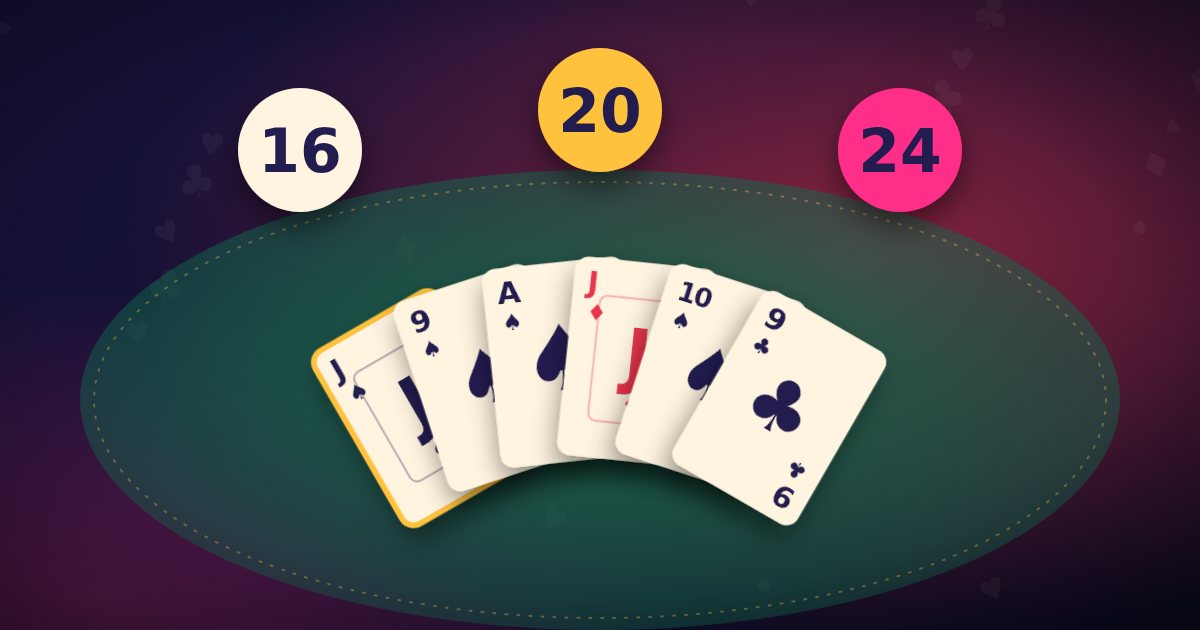
In 29, you bid after seeing only four of your eight cards. That's what makes bidding so tense, and so important. Bid too low and you hand the trump to the other team. Bid too high and you'll struggle to reach your target. Here's a practical way to value your hand and decide between 16, 20 and 24. (New to the game? Read how to play 29 first.)
Step 1: value your four cards
Count what you can realistically win, not just the points you hold:
| You hold (in one suit) | Roughly worth |
|---|---|
| J + 9 | Strong: likely wins both tricks, around 5–7 points of control |
| J alone | Good, but can be trumped |
| 9 without J | Risky: the jack can capture it |
| A or 10 alone | Weak: often captured by J or 9 |
| 3–4 cards of one suit with J or 9 | Excellent trump candidate |
Rule of thumb: a hand with the J and 9 of the same suit plus one or two more cards of that suit is a solid opening bid of 16–18.
Step 2: think about trump
You bid so you can choose the trump suit. The best trump suit has:
- the jack (the highest card), ideally with the 9;
- length: 3 or more cards, because the other four arrive after bidding;
- a chance at the pair (K and Q of trumps), which reduces your target by 4 once declared.
If you'd have no good trump suit, you probably shouldn't be bidding high.
Step 3: read the table
- Your partner opened? They likely hold a jack. You can support with a small raise if you have jacks or nines of your own.
- An opponent bid 18 or more? They're strong in a suit. Push only if your hand is genuinely stronger.
- Everyone passed quickly? Points may be spread thinly, so a modest 16 might be enough to take the trump.
When to bid 16, 20 or 24
| Bid | Typical hand (four cards) |
|---|---|
| 16 | One J + 9 pair, or two jacks with little support |
| 18–19 | J + 9 plus a third card of that suit, or a spare jack elsewhere |
| 20–22 | Two jacks and a nine, with a long potential trump suit |
| 24+ | Three jacks, or J-9 of trumps with side jacks, and partner support |
Remember: points only count if your team wins the tricks containing them. Your partner's cards matter as much as yours.
After you win the bid
- Pick trump carefully. The suit with the jack and the most length usually beats the "prettiest" hand.
- Keep trump hidden as long as it helps. Leading your side-suit jacks early can collect points before anyone knows what trump is.
- Draw trumps when revealed. Pulling out opponents' trumps protects your side-suit aces and tens.
- Feed your partner. When your partner is winning a trick, drop your aces and tens onto it.
Common bidding mistakes
- Bidding on aces and tens alone: they're easily captured.
- Bidding without a trump suit in mind.
- Raising your partner's bid with no jacks or nines.
- Forgetting the last trick point: in many rules, the last trick is worth 1 extra point.
Practise bidding fast
Bidding judgement comes from experience, and hundreds of hands teach more than any guide. 29 Master lets you play hand after hand against smart bots, offline. You can also learn to remember cards in 29 to back up your bids with better play.
FAQ
What is a good opening bid in 29?
16 with a jack and nine of the same suit is a typical, safe opening bid.
How many cards do you see before bidding in 29?
Four. The remaining four cards are dealt after the bidding and trump choice.
Should I bid if I have three jacks?
Usually yes, and quite strongly. Three jacks are 9 points of top cards and give you a strong trump choice.
What does the pair do in 29?
Holding the King and Queen of trumps (the pair) lets the bidding team reduce its target by 4 after it is declared.
29 Master
The classic 29 card game, offline, against smart bots. Free, offline, on Android.