13 Card Rummy Rules: Sequences, Jokers, Declaring and Points
13 card rummy rules made simple: pure and impure sequences, sets, wild jokers, a valid declaration, how points are counted, and the 20/40 drop penalties.
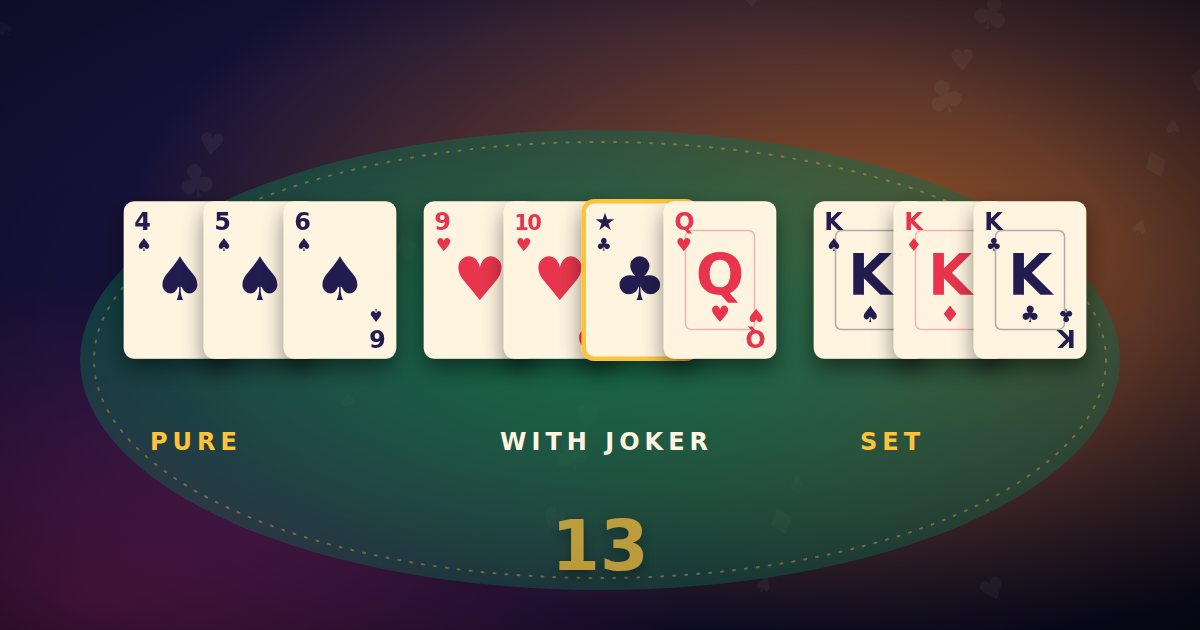
The 13 card rummy rules come down to one goal: arrange all 13 of your cards into valid sequences and sets, then declare. The key condition is that you need at least two sequences, and at least one of them must be a pure sequence with no joker in it. Without a pure sequence, your declaration isn't valid, however good the rest of your hand looks.
Thirteen-card Rummy, often called Indian Rummy, is a much-loved family game across South Asia. This guide covers the rules as a game of skill to play for fun with family and friends, scored in points. We don't cover or encourage playing for money.
Objective
Be the first player to arrange all 13 cards into valid groups and make a correct declaration. The winner scores zero; everyone else collects penalty points for the cards they haven't grouped. Lower is better.
Setup: what you need
| Item | Standard practice |
|---|---|
| Players | 2 to 6 |
| Decks | Usually two standard 52-card decks plus printed jokers; two-player games often use one deck |
| Cards per player | 13 |
| Card order | A-2-3…10-J-Q-K; ace can be low (A-2-3) or high (Q-K-A) |
| Wild cards | Printed jokers plus a randomly chosen "wild joker" rank |
After the deal:
- One card is drawn at random and placed face up, partly under the pile. Its rank becomes the wild joker: every card of that rank, in all four suits, is a joker for this deal.
- The remaining cards form the face-down closed deck.
- The top card is turned face up to start the open deck (the discard pile).
Sequences, sets and jokers
| Group | Rule | Example |
|---|---|---|
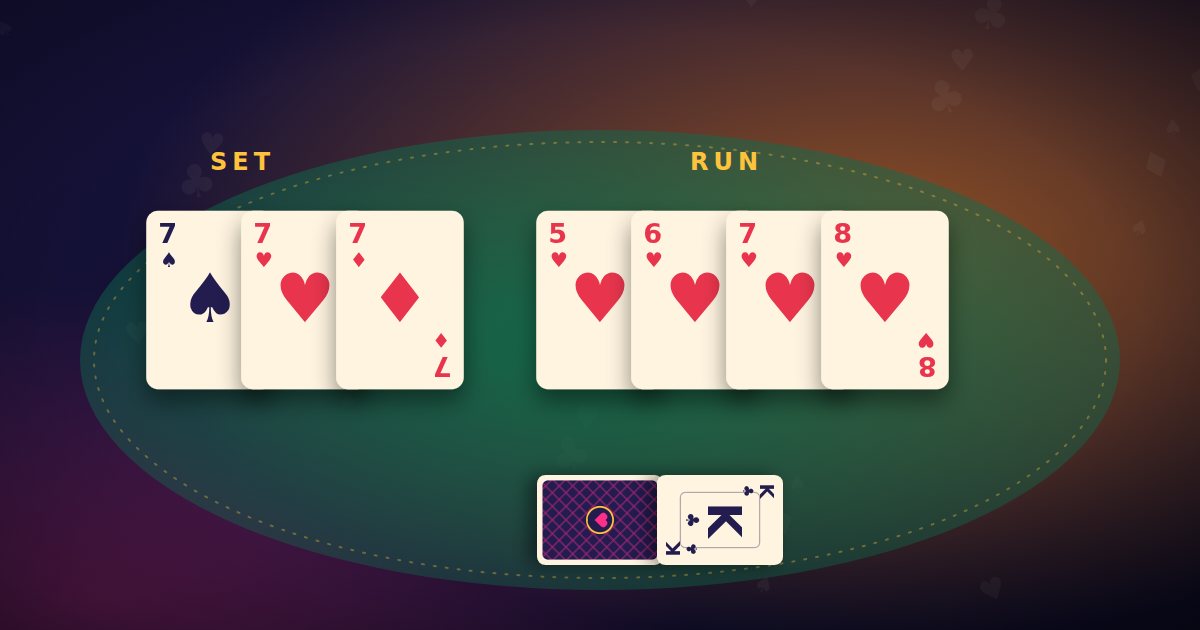
| Pure sequence | 3+ consecutive cards of the same suit, no joker | 5♥ 6♥ 7♥ |
| Impure sequence | 3+ consecutive cards of the same suit, using a joker as a substitute | 5♥ 6♥ (joker) 8♥ |
| Set | 3 or 4 cards of the same rank in different suits; jokers allowed | 9♠ 9♦ 9♣ |
Some important details:
- A sequence can't wrap round: Q-K-A is valid and A-2-3 is valid, but K-A-2 is not.
- In a set, every card must be a different suit. 9♠ 9♠ 9♦ (using cards from both decks) is not a valid set.
- A wild joker used in its natural place still counts as pure. If sevens are wild, 6♣ 7♣ 8♣ is a pure sequence.
- A sequence made entirely of jokers is generally not accepted as your pure sequence.
How a turn works
Play goes clockwise, starting with the player to the dealer's left.
- Draw one card from the closed deck or the top of the open deck.
- Discard one card face up onto the open deck, leaving you with 13 again.
- Arrange your hand as you go. Groups stay in your hand until you declare; you don't lay them on the table during play.
Declaring
When your 14th card completes your hand, discard the final card onto the finish slot (face down) and show your 13 cards grouped. A valid declaration must have:
- at least two sequences,
- at least one pure sequence,
- every remaining card in valid sequences or sets.
The other players then group their own cards to reduce their penalty points before the scores are counted.
Dropping
If you don't like your hand, you can drop (fold) out of the deal and accept a fixed penalty:
| When you drop | Penalty |
|---|---|
| First drop (before drawing your first card) | 20 points |
| Middle drop (any time after your first draw) | 40 points |
Scoring: how points are counted
The winner of the deal scores 0. Each other player scores the value of their ungrouped cards:
| Card | Points |
|---|---|
| Ace, king, queen, jack | 10 each |
| 2 to 10 | Face value |
| Printed and wild jokers | 0 |
The pure-sequence rule bites here too:
- No pure sequence: all 13 cards count, even ones in sets or impure sequences.
- A pure sequence but no second sequence: all cards except the pure sequence count.
- Two sequences including a pure one: only cards outside valid groups count.
A losing hand is capped at 80 points. A wrong declaration (claiming a finish that isn't valid) usually costs the full 80 points, and play continues for the others.
Popular formats
- Points Rummy: one deal at a time, scored as above.
- Pool Rummy: players keep a running total and are knocked out on reaching a limit, commonly 101 or 201. The last player left wins.
- Deals Rummy: a fixed number of deals; the lowest total at the end wins.
All three are perfectly good ways to play at home, keeping score on paper.
Strategy tips
- Build a pure sequence first. Nothing else matters if you can't show one.
- Use jokers for impure sequences and sets, not for the pure sequence.
- Discard high, unconnected cards early. An isolated king costs 10 points if someone declares.
- Keep "middle" cards. A 6 can connect to a 4-5 or a 7-8; an ace or king has fewer neighbours.
- Watch what others pick up from the open deck, and avoid discarding cards that help them.
- Drop early if the hand is hopeless. Twenty points is cheaper than forty, and far cheaper than eighty.
Common mistakes
- Declaring with two impure sequences and no pure one.
- Building a set with two cards of the same suit.
- Treating K-A-2 as a sequence.
- Forgetting to group your cards after someone else declares, and paying for cards you could have saved.
Related games and guides
Thirteen-card Rummy is a close cousin of standard Rummy. If you're new to the family, start with how to play Rummy, or try two-player Gin Rummy. For more on the many regional versions, see the Indian Rummy article on Wikipedia.
Play a 13-card puzzle game offline
If you love the challenge of arranging 13 cards into strong groups, Hazari gives you the same kind of puzzle every deal. Read the Hazari rules to see how it works. Card Adda has Hazari alongside Spades, Callbreak, 29 and Hearts, all offline and just for fun.
FAQ
What is a pure sequence in 13 card rummy?
A pure sequence is three or more consecutive cards of the same suit with no joker standing in for a missing card, such as 4♠ 5♠ 6♠. You need at least one to make a valid declaration.
Can you declare without a pure sequence?
No. A declaration without a pure sequence is invalid and is usually penalised with the maximum 80 points.
How many points is a drop in rummy?
A first drop, before you draw any card, usually costs 20 points. A middle drop, after you've drawn, usually costs 40 points.
What is the maximum penalty in 13 card rummy?
A losing hand is normally capped at 80 points, which is also the usual penalty for a wrong declaration.
Can a joker be used in a set?
Yes. Jokers can replace any card in a set or an impure sequence, but not in your pure sequence.
Card Adda
16 card games in one app: Spades, Callbreak, 29, Hazari and more. Free, offline, on Android.