UNO Rules: Action Cards, Wild Draw Four, Scoring and Stacking
Official UNO rules explained: setup, every action card, the Wild Draw Four challenge, when to say UNO, scoring to 500 and which house rules aren't official.
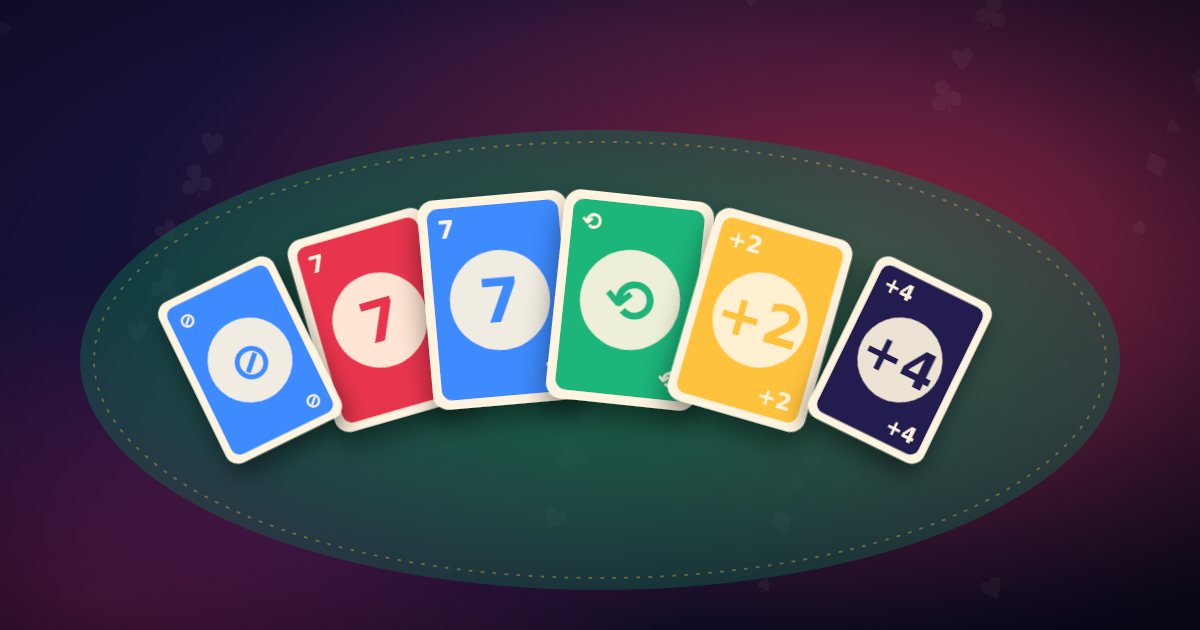
The UNO rules are simple: be the first to get rid of all your cards by matching the top card of the discard pile by colour, number or symbol. Action cards skip, reverse and make opponents draw, and Wild cards let you change the colour. Say "UNO" when you're down to one card, or you'll pay for it.
Most arguments at the UNO table come from a handful of rules people learned differently: stacking Draw Twos, playing a Wild Draw Four whenever you like, or drawing until you can play. Below are the official rules first, then the popular house rules, clearly marked.
UNO is a trademark of Mattel. Live Game Labs is not affiliated with Mattel.
Objective
Be the first player to play every card from your hand. In a single round, that's the win. In the official full game, you score points from the cards left in your opponents' hands, and the first player to reach 500 points wins.
Setup: what you need
- 2 to 10 players.
- A UNO deck. The classic deck has 108 cards; some newer editions add extra special Wild cards.
- Each player is dealt 7 cards.
- The rest form the face-down draw pile. Turn the top card over to start the discard pile.
The UNO deck at a glance
| Card | How many | What it does |
|---|---|---|
| Number cards (0–9) | 76 (one 0 and two each of 1–9 per colour) | Match by colour or number |
| Skip | 8 (2 per colour) | Next player loses their turn |
| Reverse | 8 (2 per colour) | Reverses the direction of play |
| Draw Two | 8 (2 per colour) | Next player draws 2 and loses their turn |
| Wild | 4 | Play on anything; choose the next colour |
| Wild Draw Four | 4 | Choose the colour; next player draws 4 and loses their turn (restricted, see below) |
The four colours are red, yellow, green and blue.
If the first card is an action card
- Skip: the first player is skipped.
- Reverse: the dealer plays first and play goes to the right.
- Draw Two: the first player draws 2 and is skipped.
- Wild: the first player chooses the colour.
- Wild Draw Four: return it to the deck, shuffle and turn over a new card.
How a turn works
The player to the dealer's left starts, and play normally goes clockwise.
- Match the top card of the discard pile by colour, number or symbol. A red 7 can go on a red 2 or a blue 7; a green Skip can go on any Skip.
- Or play a Wild card and name the next colour.
- If you can't (or don't want to) play, draw one card from the draw pile. If that card is playable, you may play it straight away. Otherwise your turn ends.
- Play passes to the next player.
Under the official rules you draw one card, not "keep drawing until you can play". You're also allowed to choose not to play a playable card, but then you must draw.
If the draw pile runs out, keep the top discard, shuffle the rest and turn it over as a new draw pile.
The Wild Draw Four rule
This is the most misunderstood card in the game. You may only play a Wild Draw Four when you have no card matching the current colour. Holding a matching number or action card in a different colour doesn't stop you, and neither does holding another Wild.
Challenging a Wild Draw Four
If you're hit with a Wild Draw Four and suspect it was played illegally, you can challenge. The player who played it shows you their hand privately.
| Outcome | Who draws |
|---|---|
| Challenge succeeds (they had a matching colour) | The player who played it draws 4 instead |
| Challenge fails (the play was legal) | The challenger draws 6 (the 4 plus 2 penalty) |
Saying UNO
When you play your second-to-last card, you must call "UNO!". If another player catches you before the next player begins their turn, you draw 2 penalty cards. Once the next player has started, you're safe.
Two-player UNO
With two players, a Reverse acts like a Skip, so you play again straight away. Skip and Draw Two also give you another turn, which makes chaining action cards very powerful.
Scoring and winning
When a player goes out, the round ends. They score points for every card still in their opponents' hands:
| Card | Points |
|---|---|
| Number cards | Face value (0–9) |
| Skip, Reverse, Draw Two | 20 |
| Wild, Wild Draw Four | 50 |
The first player to reach 500 points wins the game. If the last card played is a Draw Two or Wild Draw Four, the next player still draws those cards before the hand is scored.
The official rules also describe an alternative: each player keeps a running total of the points left in their own hand, and when someone reaches 500, the player with the lowest score wins.
House rules (not official)
These are popular, and fine if everyone agrees before the game. They are not part of the standard rules.
- Stacking: playing a Draw Two on a Draw Two (or a Draw Four on a Draw Four) to pass the penalty on. The official rules don't allow it; the penalised player draws and loses their turn.
- Draw until you can play: keep drawing until you find a playable card. Rounds get longer and hands get bigger.
- Jump-in: if you hold a card identical to the one just played (same colour and number), you can play it out of turn.
- Seven-O: playing a 7 lets you swap hands with someone; playing a 0 makes everyone pass hands in the direction of play.
- No finishing on an action card: some groups require the last card to be a number. Officially, you can go out on any card.
UNO strategy tips
- Save your Wilds. A Wild is your escape card when you can't match anything; don't spend it early.
- Change colour to one you're strong in, and notice which colours opponents keep drawing on; they probably don't have them.
- Dump high-value cards early in a points game. Getting caught with Wilds or action cards at the end is expensive.
- Hit the player with fewest cards. Keep Skips and Draw Twos for when the next player is close to going out.
- Hold a Wild Draw Four for the right moment. Play it legally, when you lack the colour, so a challenge only costs your opponent.
- Watch the direction. A well-timed Reverse can stop the danger player from getting their turn.
Common mistakes
- Playing a Wild Draw Four while holding the current colour (it can be challenged).
- Assuming stacking is official.
- Forgetting to say UNO, or calling it too late.
- Drawing more than one card on a turn under official rules.
Similar games and further reading
UNO belongs to the "shedding" family, where the aim is to empty your hand first. It's closely related to Crazy Eights, which you can play with a normal 52-card deck. Looking for more party-friendly picks? See our guides to card games for kids and card games for 4 players. For background on the game's history and editions, the UNO article on Wikipedia) is a good start.
Play more card games offline
If you like quick rounds with family and want something to play without the internet, Card Adda has 16 card games in one app, including Spades, Callbreak, 29, Hazari and Hearts, all playable offline against computer players. Browse more ideas in our list of games to play without internet.
FAQ
Can you stack Draw 2 cards in UNO?
Not under the official rules. If a Draw Two is played on you, you draw 2 and lose your turn. Stacking is a popular house rule, so agree on it before you start.
When can you play a Wild Draw Four?
Only when you have no card matching the colour on the discard pile. If you play it illegally and are challenged, you draw 4 instead of your opponent.
What happens if you forget to say UNO?
If another player catches you before the next player starts their turn, you draw 2 penalty cards.
How many cards do you start with in UNO?
Each player starts with 7 cards.
Can you end UNO on an action card?
Yes. Under the official rules you can go out on any card, including a Wild or Draw card. Some groups ban it as a house rule.
Card Adda
16 card games in one app: Spades, Callbreak, 29, Hazari and more. Free, offline, on Android.