How to Play Solitaire: Klondike Rules, Scoring and Winning Tips
Learn how to play solitaire (Klondike): the setup, legal moves, draw 1 vs draw 3, standard and Vegas scoring, plus easy tips to win more of your games.
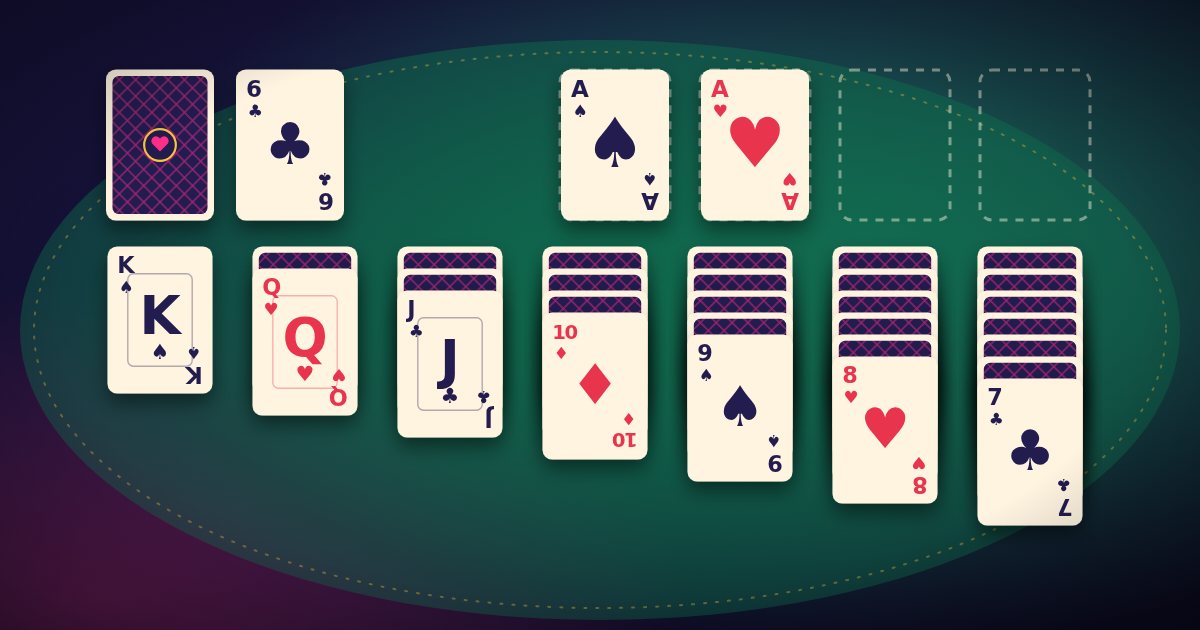
How to play solitaire in one sentence: move all 52 cards onto four foundation piles, one per suit, building each from ace up to king. You get there by shuffling cards around seven columns on the table, stacking them downwards in alternating colours, and drawing from a stock pile when you get stuck.
The version most people mean by "solitaire" is Klondike, the one-player game that came pre-installed on millions of computers. Below you'll find the exact layout, every legal move, the difference between draw 1 and draw 3, how scoring works, and the habits that turn a frustrating game into a winnable one.
Objective
Build four foundations, one for each suit (spades, hearts, diamonds, clubs). Each foundation starts with the ace and climbs in order: A, 2, 3 … 10, J, Q, K. When all four foundations reach the king, you've won.
Setup: dealing a game of Klondike
You need one standard 52-card deck with no jokers. Shuffle well (our guide on how to shuffle cards helps if the deck is new), then deal the tableau: seven columns from left to right.
- Column 1 gets 1 card, column 2 gets 2 cards, and so on up to column 7 with 7 cards.
- Only the top card of each column is face up; the rest are face down.
- That uses 28 cards. The remaining 24 cards form the stock, placed face down.
- Leave space above the tableau for the four foundations and next to the stock for the waste pile.
| Area | Cards at start | What it's for |
|---|---|---|
| Tableau | 28 (7 columns, 1 to 7 cards) | Where most of the play happens |
| Stock | 24, face down | Draw from it when you're stuck |
| Waste | 0 | Cards turned from the stock, top one playable |
| Foundations | 0 | Four piles, ace to king, one per suit |
How a turn works: the legal moves
Solitaire has no real "turns", just a series of moves. These are the ones allowed.
- Build down in alternating colours. A card can go on a tableau card one rank higher and of the opposite colour. A red 6 goes on a black 7; a black jack goes on a red queen.
- Move stacks. A correctly built run of face-up cards can be moved as a unit, as long as its bottom card fits the new spot. A black 9, red 8 and black 7 can move together onto a red 10.
- Turn over hidden cards. When you move the last face-up card off a column, flip the face-down card beneath it. This is how you uncover the deal.
- Fill empty columns with kings only. An empty tableau column can only be filled by a king, or a run headed by a king.
- Play to the foundations. Aces go up as soon as they appear, then the next card of the same suit in order. You can play from the top of a tableau column or from the waste.
- Draw from the stock. Turn cards from the stock onto the waste. Only the top waste card can be played.
- Recycle the stock. When the stock runs out, turn the waste over to form a new stock. How many times you can do this depends on the rules you're playing.
In most digital versions you may also move a card back down from a foundation to the tableau, which occasionally frees up a key move. Some strict paper rules forbid it.
Draw 1 vs draw 3
This is the biggest rule choice in Klondike, and it changes the game completely.
- Draw 1: you turn one card at a time from the stock. Every card in the stock is reachable on every pass, so the game is more forgiving. Ideal for beginners.
- Draw 3: you turn three cards at once but can only play the top one. Cards underneath are locked until you play the top card, so the order is fixed and many cards stay buried. It's harder and more strategic.
| Option | Difficulty | Stock passes usually allowed |
|---|---|---|
| Draw 1, unlimited passes | Easiest | Unlimited |
| Draw 3, unlimited passes | Medium | Unlimited |
| Draw 1, Vegas rules | Hard | 1 |
| Draw 3, Vegas rules | Hardest | 3 |
The number of passes through the stock varies a lot between apps and households, so check the settings or agree before you start.
Scoring and winning
You win by completing all four foundations. Many people play just for the win, but two scoring systems are common.
Standard scoring (the style used by classic computer versions) rewards progress:
| Move | Points |
|---|---|
| Card from waste to tableau | +5 |
| Turning over a face-down tableau card | +5 |
| Any card to a foundation | +10 |
| Card from foundation back to tableau | −15 |
Some versions also deduct points for time or for recycling the stock, and add a time bonus for a fast win. These details differ between programs.
Vegas scoring treats each deal like a bet in points: you start at −52 and earn +5 for every card you get onto a foundation. Clearing all 52 cards would give +208. It's usually played with limited stock passes, which is what makes it hard. Treat it as a scoring game for fun, nothing more.
Is every game of solitaire winnable?
No. Some deals are impossible however well you play, because a crucial card is buried under cards that can't move. Computer analyses suggest that a large majority of draw-1 deals could be won in theory if you could see every hidden card, but real players with face-down cards win far fewer. Draw 3 lowers your chances further. Many apps offer "winnable deals only" if you'd rather not meet a dead end.
8 tips to win more solitaire games
- Scan before you move. Look at every possible move first, not just the first one you see.
- Turn over face-down cards first. Prefer moves that reveal hidden cards, especially from the longest columns, where most cards are buried.
- Don't rush cards to the foundations. Aces and 2s should go up immediately, but a mid-ranked card can be more useful in the tableau as a place to park another card.
- Empty a column only when you have a king ready. An empty space is wasted unless you can fill it with a king that unlocks something.
- Choose kings carefully. If both a red and a black king could fill a gap, pick the one whose colour suits the queens you can see.
- Work the stock early, but thoughtfully. In draw 3, playing one card from the waste changes which cards appear on the next pass.
- Keep colours balanced. Avoid building long runs on one colour if the other colour's cards are stuck.
- Use undo to learn, not to cheat yourself. If your app offers undo, try a line, see where it leads and learn the pattern.
Common mistakes
- Moving a card just because you can. Every move should either reveal a card or set up the next one.
- Emptying a column with no king available. It feels like progress but often isn't.
- Forgetting the waste in draw 3. The order of the stock shifts when you play from it, so a card that seemed lost may appear next pass.
- Ignoring the foundation-back-down move, where your version allows it.
Other solitaire games to try
Once Klondike feels easy, Spider Solitaire uses two decks and rewards longer planning. If you'd rather play with other people, see our list of card games for 2 players. For the full history and dozens of variants, the Klondike article on Wikipedia) is a good reference.
Play card games offline
Solitaire fans who enjoy a quiet game without an internet connection might like ADDA No Wifi Games, a collection of card and board games that work fully offline. If you want to try trick-taking games like Spades, Callbreak and Hearts against computer players, Card Adda has 16 card games in one app.
FAQ
What are the basic rules of solitaire?
Deal seven tableau columns, build them downward in alternating colours, and move cards to four foundations from ace to king by suit. Only kings can fill empty columns, and you draw from the stock when stuck.
Is solitaire draw 1 or draw 3?
Both are standard. Draw 1 is easier and good for learning; draw 3 is the traditional, harder version.
Can you put any card in an empty space in solitaire?
In Klondike, only a king (or a run starting with a king) can go into an empty tableau column.
Why can't I win solitaire every time?
Some deals are impossible to win, and hidden cards mean you can't always see the right path. Playing draw 1 and revealing face-down cards first will raise your win rate.
What is the difference between solitaire and Klondike?
"Solitaire" (or "patience") is the name for the whole family of one-player card games. Klondike is the most popular one, so people often use the two names interchangeably.
ADDA No Wifi Games
Cards and board games that work fully offline. Free, offline, on Android.