Spider Solitaire Rules: How to Play 1, 2 and 4 Suit Spider
Spider solitaire rules made simple: the two-deck setup, legal moves, dealing from the stock, scoring, and how 1, 2 and 4 suit Spider differ, plus tips to win.
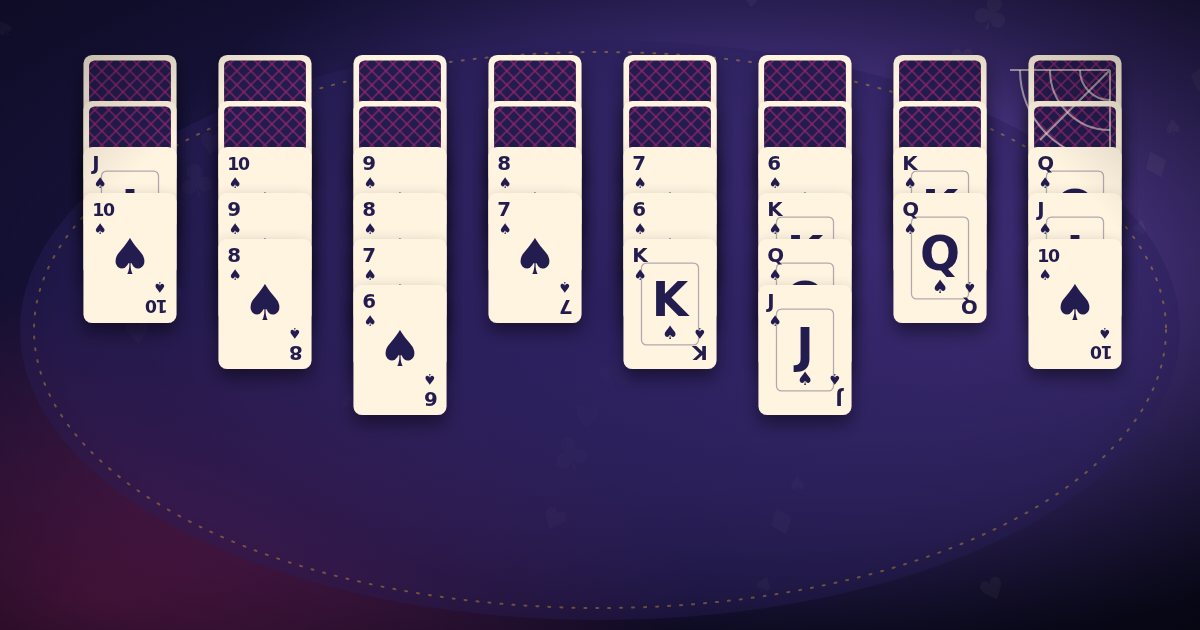
Spider solitaire rules in a nutshell: using two decks, build eight complete sequences from king down to ace in a single suit. Each finished run is cleared off the table, and when all eight are gone, you've won. You can stack any card on one a rank higher, but you can only move groups of cards together if they're the same suit.
That one twist, mixed-suit stacking but same-suit moving, is what makes Spider so absorbing. It's also why the game comes in three difficulty levels: 1 suit, 2 suits and 4 suits. Here's the full setup, every legal move, how dealing works and the strategy that wins games.
Objective
Assemble eight full sequences, each running K, Q, J, 10, 9, 8, 7, 6, 5, 4, 3, 2, A in one suit. A complete sequence is removed to the foundation area (most apps do this automatically). Clear all 104 cards and the game is won.
Unlike Klondike solitaire, you never build foundations up from the ace one card at a time. Everything happens in the tableau.
Setup: what you need
Spider uses 104 cards: two standard 52-card decks without jokers. In the 1-suit and 2-suit versions, the 104 cards are made up of fewer suits, repeated (more on that below).
- Deal 10 tableau columns.
- The first four columns get 6 cards each; the other six get 5 cards each. That's 54 cards.
- Only the top card of each column is face up.
- The remaining 50 cards form the stock, which you'll deal in five rounds of 10.
| Item | Detail |
|---|---|
| Cards | 104 (two decks) |
| Tableau | 10 columns, 54 cards (4 × 6, then 6 × 5) |
| Stock | 50 cards = 5 deals of 10 |
| Goal | 8 complete K-to-A same-suit runs |
| Empty column | Any card or valid run can fill it |
How a turn works: legal moves
- Place a card on one rank higher, any suit. A 7 can go on any 8: spade, heart, diamond or club. Colour doesn't matter.
- Move runs only if they're same-suit. A run like 9♠ 8♠ 7♠ can move as a unit onto any 10. But 9♠ 8♥ 7♠ cannot move together; you'd have to move the 7♠ alone.
- Turn up hidden cards. When a face-down card is uncovered, flip it.
- Fill empty columns with anything. An empty column can take any single card or any movable same-suit run. This is very different from Klondike, where only kings are allowed.
- Deal from the stock. When you're stuck, deal one card face up onto each of the 10 columns. In standard rules, every column must contain at least one card before you can deal.
- Clear complete runs. Once a column shows K down to A in one suit, that run is removed.
Kings can't be placed on anything, so the only way to move a king is into an empty column.
1 suit vs 2 suits vs 4 suits
The number of suits changes how often your stacks are "clean" (same suit), and therefore how easily you can move them.
| Version | Suits used | How the 104 cards are made up | Difficulty |
|---|---|---|---|
| 1 suit | Spades only | 8 sets of A to K in spades | Beginner |
| 2 suits | Spades and hearts | 4 sets of each suit | Intermediate |
| 4 suits | All four | 2 sets of each suit | Expert |
1-suit Spider
Every card is a spade, so every correctly ordered run can move. It's the best way to learn the game, and patient players win most deals.
2-suit Spider
Now you have to think about colour. A heart on a spade still works for building, but it blocks you from moving the run underneath. Wins come less often and need more planning.
4-suit Spider
The classic expert challenge. With four suits, mixed-suit stacks form constantly, and untangling them takes long-term planning. Even strong players lose plenty of 4-suit games; don't be discouraged.
Scoring and winning
You win when all eight runs are cleared. Many apps use the scoring system made familiar by classic computer versions:
| Event | Points |
|---|---|
| Starting score | 500 |
| Every move | −1 |
| Each completed suit run | +100 |
So a fast win scores higher than a slow one. Some apps also track time and number of moves, and undo may cost a point. Rules on undo and scoring vary from app to app.
8 Spider solitaire strategy tips
- Expose face-down cards first. Hidden cards are the main thing standing between you and a win. Favour moves that uncover them, especially in the taller left-hand columns.
- Build same-suit wherever possible. If a 6♥ could go on 7♥ or 7♠, choose the heart. Same-suit stacks stay movable.
- Prize empty columns. An empty column is your most powerful tool. Use it to rearrange stacks and sort suits, not as a dumping ground.
- Don't deal from the stock too early. Each deal drops a random card on every column and can bury your progress. Make every useful move first.
- But do fill gaps before dealing. Since you can't deal with an empty column, park something there, ideally a card that's easy to move again.
- Put high cards in empty columns. A king or queen in an empty column gives you room to build a long run below it.
- Think about which column to clear. A short column is quicker to empty, and an empty column often unlocks several moves.
- Use undo to explore, if your version allows it. Try a line, see what you uncover, and back out if it leads nowhere.
Common mistakes
- Building mixed suits without a plan. It's legal, but every mixed join is a future knot.
- Dealing the stock in a panic. Check every column for a legal move first.
- Leaving a column empty when you need to deal. Standard rules won't let you, so fill it first.
- Jumping straight to 4 suits. Learn the patterns at 1 or 2 suits, then step up.
- Ignoring complete runs in mixed stacks. Sometimes the cards you need for a full K-to-A run are spread across columns; sort them using an empty column.
Variations you might see
- Spiderette uses one deck and a Klondike-style seven-column deal, with Spider's building rules.
- Relaxed dealing: some apps let you deal from the stock even with empty columns.
- Unlimited undo vs limited undo: varies widely, and changes how hard the game feels.
For more on the family of patience games, the Spider solitaire article on Wikipedia) is a good reference. And if you enjoy the memory side of Spider, our guide to how to remember cards has techniques that help in many games.
Play card games offline
If you like the calm focus of Spider, ADDA No Wifi Games offers card and board games that work fully offline, handy when you're travelling or saving data. For more ideas, see our list of games to play without internet.
FAQ
How do you play Spider solitaire for beginners?
Start with the 1-suit version. Stack cards in descending order, turn over hidden cards, and deal from the stock only when no useful moves remain. Complete K-to-A runs clear automatically.
Can you put any card in an empty space in Spider solitaire?
Yes. Unlike Klondike, any single card or movable same-suit run can go into an empty column.
Why can't I deal in Spider solitaire?
Under standard rules, you can't deal from the stock while any column is empty. Move a card into the empty column, then deal.
How many cards are in Spider solitaire?
104 cards, which is two full decks. 54 are dealt to the tableau and 50 make up the stock.
Is 4-suit Spider solitaire always winnable?
No. Some deals can't be won, and 4-suit games are much harder than 1-suit games. Careful planning and good use of empty columns raise your win rate.
ADDA No Wifi Games
Cards and board games that work fully offline. Free, offline, on Android.