How to Play Dominoes: Rules for Block, Draw and All Fives
Learn how to play dominoes with a double-six set: dealing, matching ends, Block and Draw games, spinners, All Fives (Muggins) scoring and winning tips.
How to play dominoes in one sentence: take turns laying tiles end to end so the touching halves match, and try to be the first to empty your hand. That's the heart of almost every dominoes game, from a quiet two-player match to a loud table of four slamming tiles down.
The details change from game to game, so this guide starts with the standard double-six set and the two classic games, Block and Draw. Then it covers spinners and the popular scoring game All Fives, also called Muggins.
Objective
In Block and Draw dominoes, you want to play all your tiles first. When you do, you score the pips (dots) left in your opponents' hands. If nobody can go out, the player with the lowest pip count wins the hand. Games are usually played over several hands to an agreed target, such as 100 or 150 points.
What you need
A double-six set is the standard. It has 28 tiles, one for every pairing of 0 (blank) to 6, including seven doubles (0-0, 1-1 and so on up to 6-6).
| Item | Detail |
|---|---|
| Tiles | 28 in a double-six set |
| Pips per end | 0 (blank) to 6 |
| Doubles | 7 (blank-blank to 6-6) |
| Players | 2 to 4 (4 can play as 2 partnerships) |
| Tiles each | Usually 7 with 2 players; often 5 with 3 or 4 in the Draw game |
| Boneyard | The face-down tiles left after dealing |
Bigger sets (double-nine, double-twelve) exist for larger groups and games like Mexican Train, but the double-six set is what most people mean by dominoes.
Setting up
- Place all tiles face down and shuffle them around the table.
- Each player draws their hand. Stand your tiles on edge so only you can see them.
- The remaining tiles form the boneyard (in the Draw game) or are set aside (in the Block game).
- Decide who starts. A common rule is that the player holding the highest double (6-6 if it's out) plays it first. Other tables let each player draw one tile, and the heaviest tile leads. After the first hand, the winner of the previous hand often starts.
How a turn works
The first tile laid starts the line of play. From then on, each turn you add one tile to an open end of the line, and the touching halves must show the same number.
- A 6-4 can be placed next to an open 6 or an open 4.
- Doubles are usually placed crosswise (sideways), which makes them easy to spot. They still have only one number to match on.
- The line can bend around corners when it runs out of table. Only the open ends matter.
Play passes clockwise. What happens when you can't play depends on the game.
The Block game
In Block dominoes, if you can't match either open end, you simply pass. There's no drawing. The hand ends when someone goes out or when nobody can play (the game is "blocked").
With two players, each takes 7 tiles and the other 14 stay out of play, which makes Block quite tactical: you never know exactly what your opponent is holding.
The Draw game
In Draw dominoes, if you can't play, you must draw from the boneyard until you get a tile that fits, then play it. Some tables say you may draw even when you could play; others forbid it. Many rules also say the last one or two tiles in the boneyard can't be drawn. Once the boneyard is empty (or at that limit), you pass if you can't play.
Drawing means you're rarely stuck, but every tile you pick up is a liability if someone else goes out.
Scoring and winning
| Situation | Who scores | What they score |
|---|---|---|
| A player goes out (dominoes) | That player (or partnership) | Total pips left in all opponents' hands |
| Game blocked | Player with the lowest pip total | Total pips of the other hands (some tables subtract their own) |
| Blocked with a tie | Nobody, in many rules | Hand is replayed or scored as a draw |
The first player or team to reach the agreed target wins. House rules vary a lot here, so agree on the target and on blocked-game scoring before you start.
Spinners
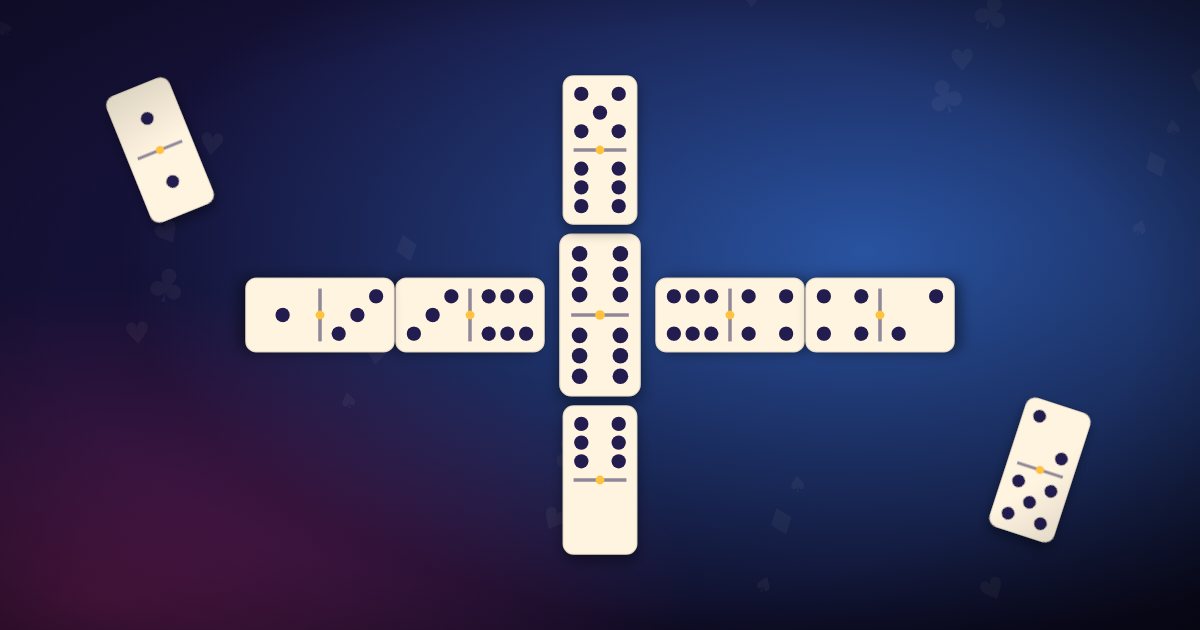
In some games the first double played becomes a spinner. Instead of having two open ends, a spinner can be played on from all four sides: both ends and both long sides. In most rules, the two long sides only open up once both ends of the spinner have been played on.
Spinners make the layout cross-shaped and give everyone more places to play. They're a key part of All Fives. In Block and Draw games, many tables don't use them, so check before you start.
All Fives (Muggins) scoring in brief
All Fives, also called Muggins or Fives, adds scoring during play. Every time you lay a tile, add up the pips on all the open ends. If the total is a multiple of five (5, 10, 15, 20 and so on), you score that many points.
- A double at an open end counts both halves. An open 5-5 counts as 10.
- With a spinner, the ends coming off it count too once they're in play.
- Example: the open ends show 6, 4 and a crosswise 5-5. That's 6 + 4 + 10 = 20, so you score 20.
- At the end of the hand, the player who goes out also scores the opponents' remaining pips, usually rounded to the nearest five.
- The name Muggins comes from a traditional rule: if you forget to claim your points, an opponent can call "Muggins!" and take them. Many friendly tables skip this.
Targets differ from table to table. Some count scores in units of five on a cribbage board; others play to a few hundred points. Agree on yours first.
Variations you'll meet
- Partnership dominoes: four players, partners opposite, sharing one score. It's very popular across the Caribbean and Latin America.
- Bigger sets: double-nine sets for more players or longer games.
- Mexican Train: a different game played with double-twelve tiles, where each player builds their own "train".
- Opening rules: some insist the first tile must be a double; others allow anything.
- Pip counting: some count the 0-0 as 0, others give it a nominal value in blocked games.
Strategy tips
- Play heavy tiles early. High-pip tiles like 6-5 and 6-6 cost you the most if someone goes out, so get rid of them when the play is otherwise equal.
- Keep variety in your hand. Holding several different numbers gives you more ways to play later and makes you harder to block.
- Watch what opponents pass on. If a player passes or draws when a 3 is open, they probably have no 3s. Use that to block them.
- Count the suit. Each number appears on seven tiles. If five tiles with a 4 have been played and you hold the other two, you control the 4s.
- Don't strand your doubles. A double can only match one number, so play it while that number is still open.
- In All Fives, think about the next total. Avoid leaving ends that let your opponent make 10 or 15 easily.
Common mistakes
- Forgetting the double counts double in All Fives scoring.
- Arguing about blocked games because nobody agreed on the rule beforehand.
- Hoarding high tiles for "later" and getting caught when someone goes out.
- Playing the spinner's long sides too early when your table requires both ends first.
Other classic games to try
If you enjoy the counting and blocking in dominoes, backgammon mixes dice luck with planning, and checkers is pure strategy with simple pieces. For more ideas, see our list of games to play without internet. The Wikipedia dominoes article covers the many regional games.
Play classic board games offline
If you love classic table games, Board Adda: Ludo Carrom Chess has 13 of them, including Ludo, carrom, chess and checkers, all playable offline against the computer.
FAQ
How many dominoes do you get in a hand?
With a double-six set, two players usually take 7 tiles each. In the Draw game with 3 or 4 players, 5 each is common, though some tables deal 7 to everyone.
Who goes first in dominoes?
Usually the player with the highest double, often the 6-6, plays first. After the first hand, many tables let the previous hand's winner start.
What happens if no one can play in dominoes?
The game is blocked. Players count the pips in their hands, and the lowest total wins the hand.
What is the difference between Block and Draw dominoes?
In Block dominoes you pass if you can't play. In Draw dominoes you must take tiles from the boneyard until you can play.
How do you score in Muggins?
After each play, add the pips on all open ends. If the total is a multiple of five, you score it, and a double at an end counts both halves.
Board Adda: Ludo Carrom Chess
Ludo, carrom, chess and 10 more board games. Free, offline, on Android.