Snakes and Ladders Rules: How to Play, Variations and History
Snakes and ladders rules made simple: setup, turns, climbing ladders, sliding down snakes, exact-roll finishes, popular house rules and how it compares to Ludo.
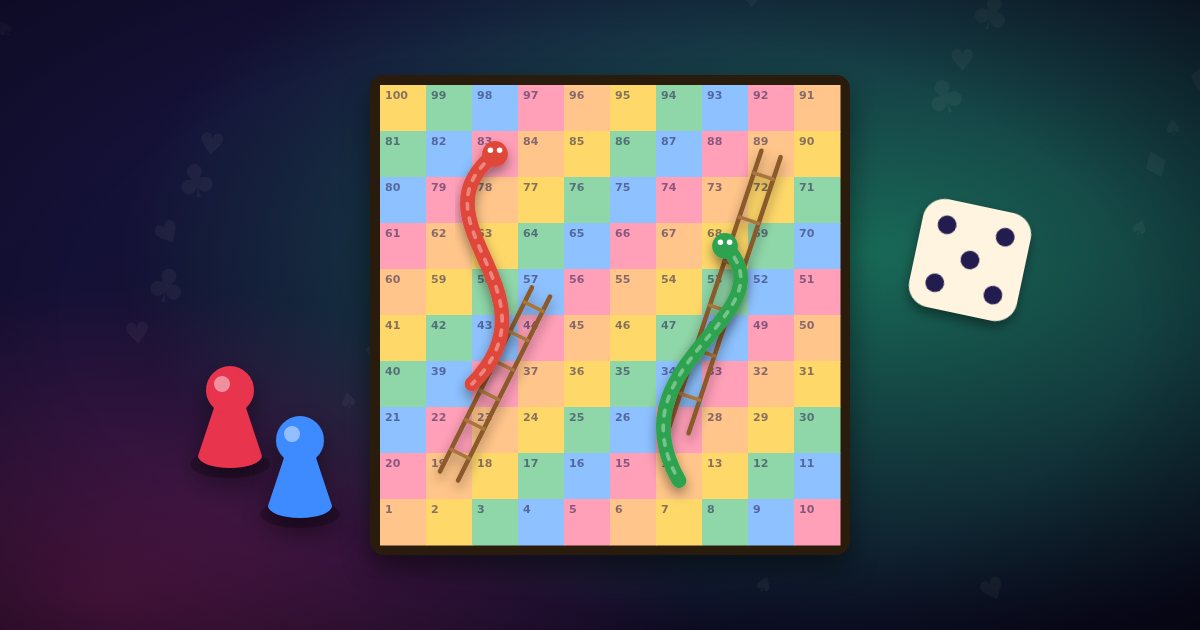
The snakes and ladders rules fit on a sticky note: roll a die, move your counter that many squares, climb up any ladder you land at the bottom of, slide down any snake whose head you land on, and be the first to reach the last square. That's the whole game.
It's pure luck, which is exactly why it works so well with young children and mixed-age family groups: anyone can win. Below are the standard rules, the house rules people argue about, a short look at the game's roots and how it compares to Ludo.
Objective
Be the first player to move your counter from square 1 to square 100 (or the last square on your board). There's no capturing and no strategy to speak of. The dice decide.
What you need
| Item | Detail |
|---|---|
| Board | Usually a 10 × 10 grid numbered 1 to 100 |
| Snakes and ladders | Printed on the board; the number and layout vary |
| Die | One standard six-sided die |
| Counters | One per player, each a different colour |
| Players | 2 or more; 2 to 4 is typical |
The squares are numbered in a zigzag (often called boustrophedon): left to right along the bottom row, right to left along the next, and so on up the board. Follow the numbers, not the direction of the row.
Setting up
- Each player chooses a counter.
- All counters start off the board, just before square 1.
- Everyone rolls the die; the highest roll goes first, and play passes clockwise.
How a turn works
- Roll the die and move your counter forward that many squares.
- Ladder: if you finish your move on the square at the bottom of a ladder, move straight up to the square at its top.
- Snake: if you finish your move on the square with a snake's head, slide down to the square at its tail.
- Landing on the top of a ladder or the tail of a snake does nothing. Only the bottom of a ladder and the head of a snake count.
- Play passes to the next player.
Sharing squares: in the standard game, several counters can sit on the same square. Unlike in Ludo, you don't knock anyone off.
Winning
The first player to land on square 100 wins. Whether you need an exact roll to finish is the most common rules disagreement, so settle it before you start (see the next section). Some families keep playing to decide second and third place.
Common variations
Snakes and ladders has no single official rulebook, so house rules are everywhere. These are the ones you'll meet most often.
| Variation | How it works | Effect |
|---|---|---|
| Exact roll to finish | You must roll the exact number to land on 100 | Adds tension near the end |
| Bounce back | If your roll overshoots 100, count forward to 100 and then back for the extra squares | Can land you on a late snake |
| Extra turn on a 6 | Rolling a 6 gives you another roll | Speeds the game up |
| Three 6s rule | Rolling three 6s in a row cancels the turn (some send you back to the start) | Stops runaway turns |
| Need a 6 to start | You must roll a 6 to enter the board | Borrowed from Ludo; slows the start |
| Two dice | Roll two dice and move the total | Faster games on big boards |
Exact roll vs. bounce back
With an exact roll rule, if you're on 97 you need exactly a 3. A roll of 4, 5 or 6 means you either stay put or, with the bounce back rule, move to 100 and back again. Rolling a 5 from 97 would take you to 100, then back to 98. Bounce back is popular because it keeps the snakes near the top relevant until the very end.
Extra turn on a 6
Many families play that a 6 earns another roll, just like in Ludo. If you add this rule, it's worth adding the three 6s limit too, so one lucky player can't race up half the board in a single turn.
Where does snakes and ladders come from?
The game is usually traced to India, where older versions are known by names such as Moksha Patam or Gyan Chaupar. In these versions the board was a moral lesson: ladders were linked to virtues and snakes to vices, and reaching the end stood for spiritual liberation (moksha). Exact origins and dates are debated, so treat any precise claims with care.
The game later travelled to Britain, where it became Snakes and Ladders, and on to the United States, where a version is sold as Chutes and Ladders. Chutes and Ladders is a trademark of its owner; we're not affiliated. The Wikipedia article on snakes and ladders has more on its history.
Snakes and ladders vs. Ludo
Both are Indian-rooted race games played with dice, and they're often printed on opposite sides of the same board. But they play very differently.
| Snakes and ladders | Ludo | |
|---|---|---|
| Pieces per player | 1 | 4 |
| Choices on your turn | None: move the roll | Which token to move |
| Capturing | No | Yes, land on an opponent to send them home |
| Need a 6 to start | Only as a house rule | Yes, in standard rules |
| Luck vs. skill | Pure luck | Luck plus real decisions |
If your family has outgrown snakes and ladders, Ludo is the natural next step. Our complete Ludo rules guide explains everything, and the history of Ludo and Pachisi tells the story of its own Indian ancestor.
Tips for a better game
Since you can't change the dice, "strategy" here is mostly about making the game more fun:
- Agree on rules first. Exact roll, extra turn on 6 and starting rules cause most arguments.
- Use it to teach counting. Young children can count squares aloud and add up two dice in the two-dice variant.
- Keep it short. If games drag, play with the extra-turn-on-6 rule or two dice.
- Make your own board. Drawing a custom board with your own snakes and ladders is a great rainy-day activity.
- Be a good sport. Landing on the long snake at 99 happens to everyone, and it's part of the fun.
Common mistakes
- Moving in the wrong direction on a row. Always follow the numbers.
- Climbing down ladders or up snakes. Ladders only go up; snakes only go down.
- Triggering a ladder or snake you only passed. Only the square you finish on counts.
- Counting the starting square. Your first step from off the board lands on square 1 when you roll a 1.
Play family board games offline
If your family enjoys dice races, Board Adda: Ludo Carrom Chess brings you Ludo, the next step up, plus carrom, chess, checkers and more of its 13 classic board games, all offline. Want more ideas? Read our Ludo tips to win.
FAQ
Do you need an exact roll to win snakes and ladders?
It depends on your house rules. Many families play that you need the exact number to land on 100, while others let any roll that reaches 100 win.
Do you need a 6 to start snakes and ladders?
Not in the standard game: everyone starts off the board and moves on their first roll. Needing a 6 to start is a house rule borrowed from Ludo.
Do you get another turn if you roll a 6 in snakes and ladders?
Only if you play that house rule. It's a popular one, often paired with a limit of three 6s in a row.
Can two players be on the same square in snakes and ladders?
Yes. Counters can share a square, and nobody is sent back for it.
Is snakes and ladders a game of skill or luck?
It's pure luck. Every move is decided by the die, which is why it's a good first board game for young children.
Board Adda: Ludo Carrom Chess
Ludo, carrom, chess and 10 more board games. Free, offline, on Android.