Checkers Rules: How to Play, Jumps, Kings and How to Win
Learn the official checkers rules: board setup, how men move, mandatory captures, multi-jumps, kings, draws, and how to win, plus key strategy tips.
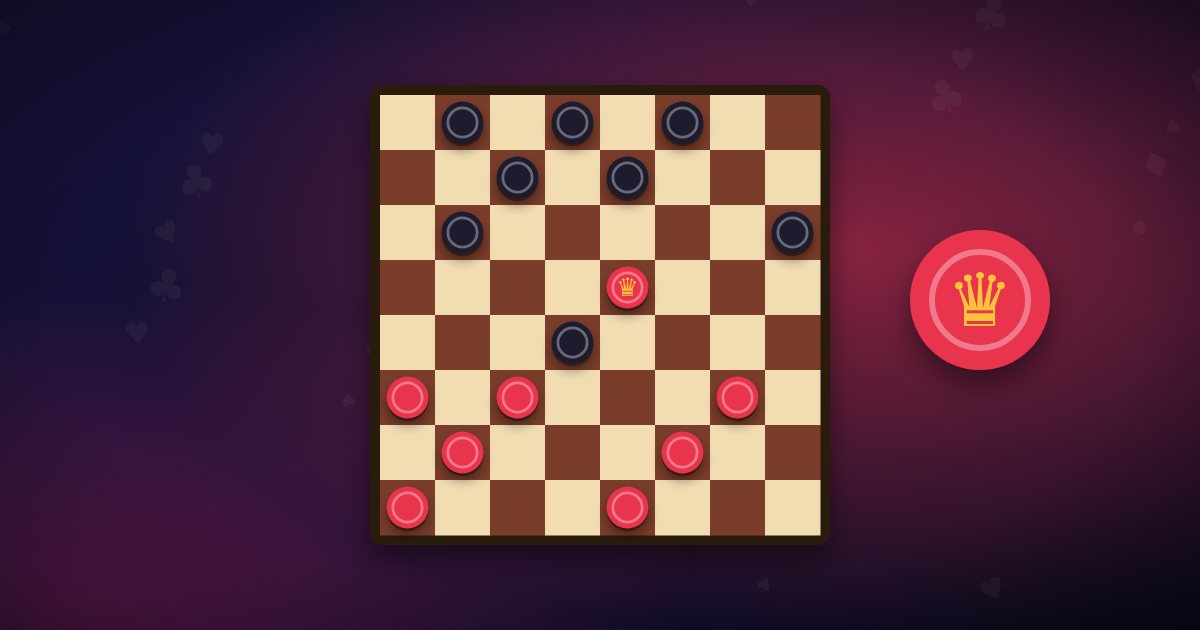
Checkers rules fit on a postcard: two players, 12 pieces each, and everything moves diagonally on the dark squares. You capture by jumping over an enemy piece, and if a capture is available, you must take it. Reach the far side and your piece becomes a king that can move backwards too. You win by capturing all your opponent's pieces or leaving them with no legal move.
This guide covers American checkers, also called English draughts, the 8×8 game most people learn first. We'll finish with how the 10×10 international version differs.
Objective
Win by leaving your opponent unable to move. That happens in one of two ways:
- You capture all of their pieces.
- Every piece they have left is blocked and has no legal move.
If neither player can force a win, the game is a draw.
Setup: what you need
| Item | Detail |
|---|---|
| Players | 2 |
| Board | 8×8, 64 squares, alternating light and dark |
| Pieces | 12 per player (usually dark/red vs light/white) |
| Playing squares | Dark squares only |
| Board position | Each player has a dark square in their near left-hand corner |
| Starting rows | Each side fills the dark squares of its first 3 rows |
| First move | Dark (black or red) moves first in standard rules |
With 12 pieces each on the three nearest rows, two rows in the middle start empty. That's your battleground.
How a turn works
On your turn you make one move with one piece. Uncrowned pieces are called men.
Moving a man
- A man moves one square diagonally forward onto an empty dark square.
- Men can never move backwards (except that a king can, see below).
Capturing (jumping)
- If an enemy piece sits diagonally next to your man, and the square directly beyond it is empty, you can jump over it.
- The jumped piece is removed from the board.
- Men only jump forwards in American checkers.
Capturing is mandatory
This is the rule beginners forget most. If you can capture, you must. If you have more than one capture available, you may choose which one to make. In American checkers you don't have to pick the capture that takes the most pieces.
Multi-jumps
If, after a jump, your piece lands where it can jump again, it must keep jumping in the same turn. A double or triple jump can change direction (a man still only jumps forwards; a king can zigzag in any direction). You can't stop partway through a sequence you've started.
Huffing: an old rule
Older rules let your opponent "huff", removing a piece that failed to make a required capture. Official rules dropped huffing long ago: today, if a player misses a capture, the move is simply taken back and the capture made. Some families still play huffing as a house rule, so agree before you start.
Kings
When a man reaches the far row (your opponent's back row), it is crowned. Your opponent places one of your captured pieces on top of it to make a stacked king.
- A king moves one square diagonally in any direction, forwards or backwards.
- A king can jump forwards and backwards, including in multi-jump sequences.
- If a man reaches the back row by jumping, its turn ends there. It is crowned, but it can't keep jumping as a king until your next turn.
Kings in American checkers move only one square at a time. "Flying kings" that glide along a whole diagonal belong to international draughts.
Winning and draws
| Result | How it happens |
|---|---|
| Win | Opponent has no pieces left |
| Win | Opponent's remaining pieces are all blocked |
| Win | Opponent resigns |
| Draw | Both players agree |
| Draw | Neither side can make progress (tournament play uses a move-count rule to claim this) |
In casual games, a draw usually comes when you're each left with one or two kings chasing each other round the board. Tournament rules let a player claim a draw when no progress is being made over a set number of moves; the exact count depends on the rule set.
Variations
International draughts (10×10)
International draughts is the version used in world championship play, and it is especially popular in the Netherlands and much of Africa. The big differences:
| Rule | American checkers | International draughts |
|---|---|---|
| Board | 8×8 | 10×10 |
| Pieces | 12 each | 20 each |
| First move | Dark | Light (white) |
| Men capture backwards? | No | Yes |
| Kings | Move one square | Flying kings move any distance |
| Choice of capture | Any capture | Must take the maximum number of pieces |
Other regional versions
Russian, Brazilian, Turkish and Italian draughts all tweak these rules: Turkish draughts even moves pieces orthogonally rather than diagonally. If you learnt "checkers" at home with backwards captures or flying kings, you may have learnt one of these variants. For a full list, see the Wikipedia article on draughts.
Common house rules
- Optional capture: jumping isn't forced. This makes the game much easier and loses most of its tactics.
- Huffing as a penalty for a missed jump.
- Kings move any distance in casual play.
Strategy tips
- Control the centre. Pieces in the middle of the board have more options and support each other.
- Keep your back row as long as you can. While your back row is occupied, your opponent can't crown a king. Many players hold two key back-row squares well into the middle game.
- Move in groups. A lone man is easy to trap; pieces that back each other up can't be jumped.
- Use forced captures against your opponent. Because captures are mandatory, you can offer one piece to drag an enemy man into a square where you then take two or three back. This "shot" is the heart of checkers tactics.
- Count before you trade. When you're ahead, even trades are good: 4 against 3 is a much bigger edge than 12 against 11.
- Get a king, then use it. A king attacks from behind and can pick off men that can't turn round.
- Watch the edges. Edge pieces can't be jumped from one side, but they also have fewer moves and can get stuck.
Common mistakes
- Forgetting a forced capture. Always check for jumps before you move, for you and your opponent.
- Rushing pieces forward alone. Speed doesn't win; support does.
- Emptying the back row early. This hands your opponent an easy king.
- Stopping a multi-jump early. If another jump is available, you must take it.
- Moving a man backwards. Only kings can do that.
If you enjoy checkers, the step up in calculation is chess. Start with our guide to chess piece values to see how the two games think differently about material.
Play checkers offline
Board Adda: Ludo Carrom Chess includes checkers among its 13 classic board games, alongside Ludo, carrom and chess. It all works offline, so you can practise forced-capture tactics against the computer anywhere. When you want a change of pace, our Ludo rules guide covers another family favourite in the same app.
FAQ
Do you have to jump in checkers?
Yes. Under standard rules, if a capture is available you must take it. If several are available, you can choose which one.
Can a regular piece move backwards in checkers?
No. Men only move and capture diagonally forwards. Only a king can move or jump backwards.
Can a king move more than one square in checkers?
Not in American checkers: a king moves one square diagonally in any direction. Kings that move any distance ("flying kings") are part of international draughts and some house rules.
Who goes first in checkers?
In standard American checkers, the darker pieces (black or red) move first.
How do you win at checkers?
You win by capturing all your opponent's pieces or blocking them so they can't make a legal move. If neither side can make progress, the game is a draw.
Board Adda: Ludo Carrom Chess
Ludo, carrom, chess and 10 more board games. Free, offline, on Android.