Chess Openings for Beginners: 6 Openings and the Key Principles
The best chess openings for beginners: core opening principles plus the Italian, Ruy Lopez, London, Queen's Gambit, Sicilian, French and Caro-Kann move by move.
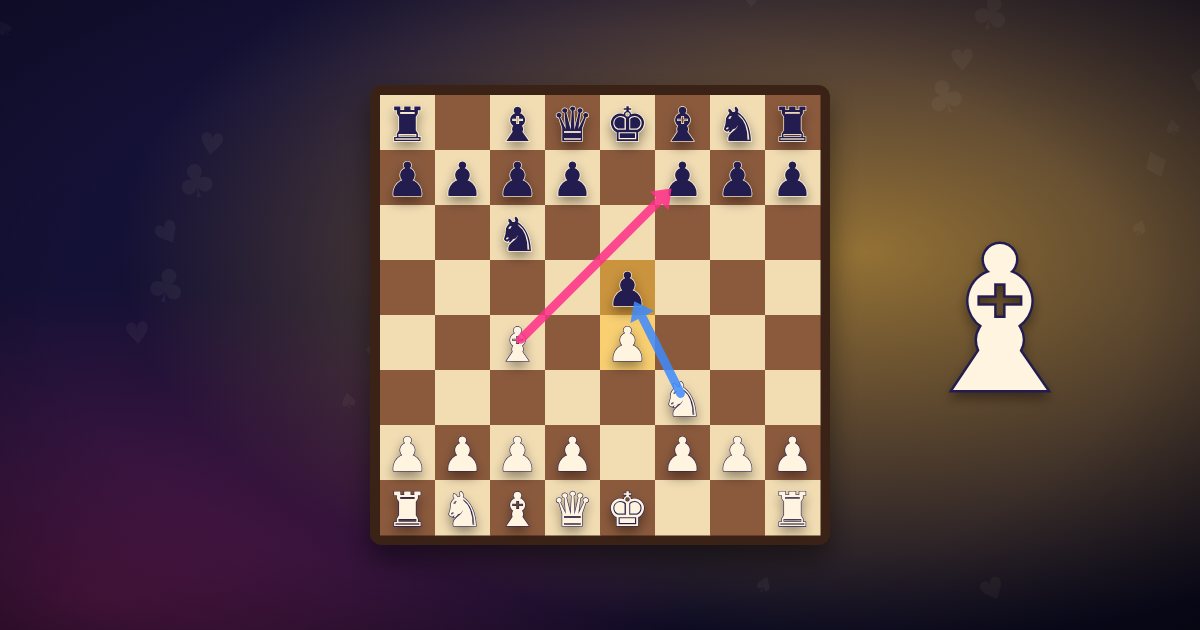
The best chess openings for beginners aren't secret traps or 20-move memorised lines. They're simple systems that follow three principles: control the centre, develop your pieces, and castle early. Learn those, then pick one opening as White and one defence for each of White's main first moves, and you'll reach a playable middle game almost every time.
Below are the principles, then six openings worth learning, with the main moves in standard algebraic notation. If you're new to notation or still learning how the pieces move, read our chess rules for beginners first.
Objective of the opening
The opening is roughly the first 10 to 15 moves. You're not trying to win there. You're trying to:
- Get your pieces out to active squares.
- Claim a share of the centre (e4, d4, e5, d5).
- Make your king safe, usually by castling.
- Connect your rooks so they can reach open files.
Do those things and you're ready to start a plan. Neglect them and even a strong player can lose quickly.
Opening principles at a glance
| Principle | What it means | Why |
|---|---|---|
| Control the centre | Play a centre pawn (e4 or d4) and aim pieces at the middle | Centre pieces reach more squares |
| Develop knights and bishops | Bring out minor pieces before moving the queen or rooks | They're the pieces that need moving first |
| Don't move a piece twice | Unless there's a good tactical reason | Each move should add something new |
| Castle early | Usually within the first 10 moves | Tucks the king away and activates a rook |
| Don't bring the queen out early | Avoid queen raids in the first few moves | She gets chased and you lose time |
| Connect your rooks | Clear the back rank between them | Rooks need open lines to be useful |
Openings for White
1. Italian Game
1.e4 e5 2.Nf3 Nc6 3.Bc4
The Italian is the classic beginner's opening. White takes the centre, develops a knight that attacks e5, and aims the bishop at f7, the weakest point in Black's camp. A quiet main line, the Giuoco Piano, continues:
3...Bc5 4.c3 Nf6 5.d3 d6 6.O-O O-O
White prepares d4 later and both sides have developed sensibly. If Black instead plays 3...Nf6 (the Two Knights Defence), the game can get sharp quickly, so study it before you meet it.
2. Ruy Lopez (Spanish Game)
1.e4 e5 2.Nf3 Nc6 3.Bb5
The bishop puts pressure on the knight that defends e5, a strain on Black's centre that lasts well into the middle game. The main line, the Morphy Defence, goes:
3...a6 4.Ba4 Nf6 5.O-O Be7 6.Re1 b5 7.Bb3 d6 8.c3 O-O
This is one of the deepest openings in chess, played from club level to world championships. For beginners, the lesson is the plan: build the centre with c3 and d4, and keep the bishop on the long a2–g8 diagonal.
3. London System
1.d4 d5 2.Bf4 Nf6 3.e3 e6 4.Nf3 c5 5.c3 Nc6 6.Nbd2 Bd6 7.Bg3
The London is a system: White sets up the same solid pawn triangle (d4, e3, c3) and develops the same pieces against almost anything Black plays. Getting the bishop out to f4 before playing e3 is the key detail, so it isn't shut in. After ...Bd6, retreating with Bg3 keeps White's dark-squared bishop and pawn structure intact. It's ideal if you want less theory to memorise.
4. Queen's Gambit
1.d4 d5 2.c4
White offers the c-pawn to pull Black's d-pawn away from the centre. It isn't a true sacrifice: if Black takes with 2...dxc4 (the Queen's Gambit Accepted), White usually wins the pawn back. Black's most common replies:
- 2...e6, the Queen's Gambit Declined. A typical line: 3.Nc3 Nf6 4.Bg5 Be7 5.e3 O-O 6.Nf3.
- 2...c6, the Slav Defence, which holds d5 without blocking the light-squared bishop.
- 2...dxc4, the Queen's Gambit Accepted.
Defences for Black
5. Sicilian Defence (against 1.e4)
1.e4 c5
The Sicilian fights for d4 from the side and creates an unbalanced game, which is why it's the most popular reply to 1.e4 at high level. The Open Sicilian main line runs:
2.Nf3 d6 3.d4 cxd4 4.Nxd4 Nf6 5.Nc3
Here 5...a6 is the famous Najdorf Variation. Be warned: the Sicilian has a huge amount of theory, so beginners often do better starting with the French or Caro-Kann below.
6. French and Caro-Kann (solid answers to 1.e4)
Both let White take the centre, then strike back at it with ...d5.
- French Defence: 1.e4 e6 2.d4 d5. Solid and strategic. The drawback is the light-squared bishop on c8, which is often hemmed in by the pawn on e6.
- Caro-Kann Defence: 1.e4 c6 2.d4 d5. Similar idea, but the bishop stays free. The Classical line continues 3.Nc3 dxe4 4.Nxe4 Bf5, getting the bishop out before ...e6.
Against 1.d4, the Queen's Gambit Declined or the Slav (above) make a natural, solid choice.
Which opening should you pick?
| If you like… | As White | As Black vs 1.e4 | As Black vs 1.d4 |
|---|---|---|---|
| Open, attacking positions | Italian Game | Sicilian | Queen's Gambit Accepted |
| Solid, steady play | London System | Caro-Kann | Slav |
| Long-term plans | Ruy Lopez, Queen's Gambit | French | Queen's Gambit Declined |
Pick one line for each column and stick with it for a few months. Understanding why the moves are played matters far more than how many lines you know.
Strategy tips for the opening
- Learn plans, not just moves. Know what you're aiming for after move 8: a pawn break, a piece to reposition, a side to attack.
- When your opponent leaves "the book", don't panic. Go back to the principles: centre, development, king safety.
- Check for threats every move. Opening traps work because someone stopped looking. See our quick chess traps guide for the classics, including Scholar's Mate.
- Count material when you're offered a pawn. Understanding chess piece values helps you decide whether a gambit is worth accepting.
- Review your games. Find the move where you left your opening and see if a principle would have helped.
Common opening mistakes
- Bringing the queen out early, then losing tempi as it gets chased.
- Moving too many pawns and leaving pieces at home.
- Delaying castling, especially when the centre opens up.
- Grabbing pawns at the cost of development.
- Playing f3 or f6 early, which weakens your king's diagonal.
- Copying moves without understanding them. If you don't know why a move is played, you won't know what to do when your opponent deviates.
Play chess offline
Board Adda: Ludo Carrom Chess includes chess among its 13 classic board games, and it works fully offline. It's a handy way to try your new openings against the computer before taking them to a club or online game. The same app also has checkers if you want a quicker game.
FAQ
What is the best chess opening for beginners?
The Italian Game (1.e4 e5 2.Nf3 Nc6 3.Bc4) is a great first choice for White because it follows every opening principle. The London System is a good alternative if you prefer a fixed setup with less theory.
What is the best defence for Black as a beginner?
Against 1.e4, the Caro-Kann or simply replying 1...e5 are solid choices. Against 1.d4, the Queen's Gambit Declined or the Slav give a sound, easy-to-understand position.
How many chess openings should a beginner learn?
Start with one opening as White and one defence each against 1.e4 and 1.d4. Three well-understood openings are worth far more than a dozen half-learnt ones.
Should beginners memorise opening theory?
Only the first few moves of your chosen lines. Beginners gain far more from understanding opening principles and practising tactics than from memorising long sequences.
Board Adda: Ludo Carrom Chess
Ludo, carrom, chess and 10 more board games. Free, offline, on Android.