Euchre Rules: How to Play, Bowers, Trump and Scoring to 10
Learn euchre rules fast: the 24-card deck, right and left bowers, ordering up, naming trump, going alone, stick the dealer and how to score to 10 points.
The basic euchre rules: four players in two partnerships use a 24-card deck, each gets five cards, one team chooses trumps, and that team must win at least three of the five tricks. Make it and you score; fail and you're "euchred", and the other team scores instead. First team to 10 points wins.
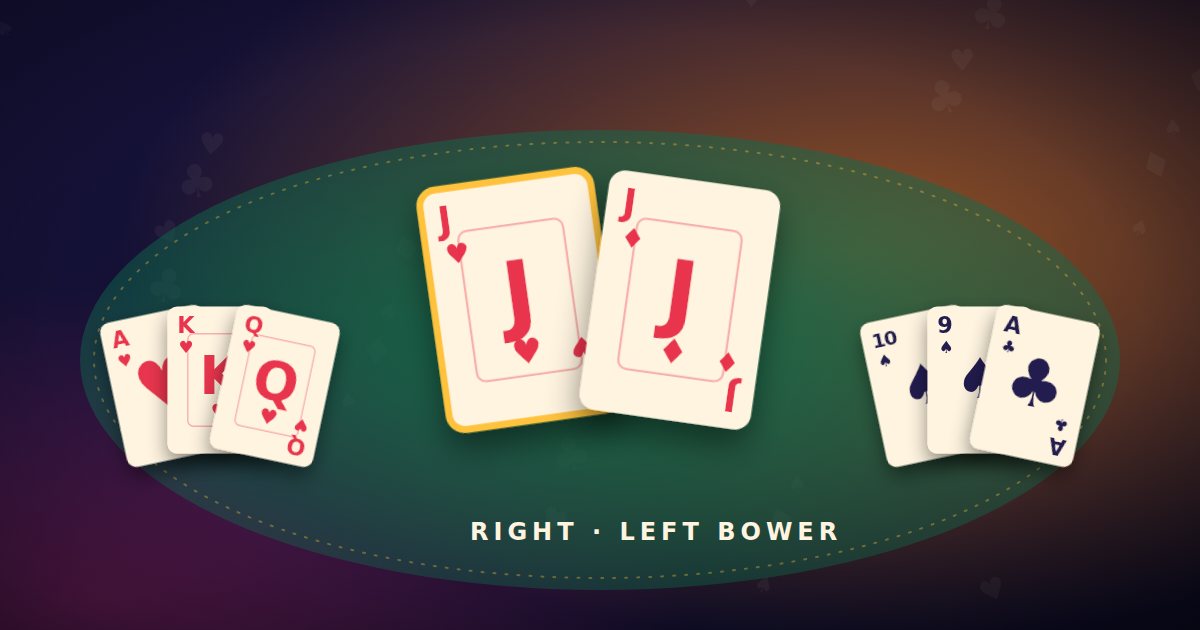
What makes euchre special is the two bowers: the jacks that become the highest trumps. Once that clicks, the rest of the game falls into place. Here's everything you need.
Objective
Win at least three tricks when your team chooses trumps, or stop the other team doing so when they choose. Points build up hand by hand until one team reaches 10.
What you need
| Item | Detail |
|---|---|
| Players | 4, in 2 partnerships, partners sitting opposite |
| Deck | 24 cards: 9, 10, J, Q, K, A in each suit |
| Hand size | 5 cards each |
| Kitty | The 4 undealt cards; the top one is turned face up |
| Game | First team to 10 points |
| Scorekeeping | Traditionally a 4 and a 6 from the unused cards |
To make a euchre deck from a standard pack, remove the 2s through 8s. The leftover 5s and 6s make handy score markers: by covering and uncovering pips, each team can show 1 to 10 points.
Card ranking: the bowers
In the trump suit, cards rank like this (highest first):
| Rank | Card (if hearts are trumps) |
|---|---|
| 1. Right bower | Jack of trumps (J♥) |
| 2. Left bower | The other jack of the same colour (J♦) |
| 3. Ace | A♥ |
| 4. King | K♥ |
| 5. Queen | Q♥ |
| 6. Ten | 10♥ |
| 7. Nine | 9♥ |
The left bower counts as a trump, not as a card of its printed suit. When hearts are trumps, the J♦ is a heart for every purpose. That leaves diamonds with only five cards in that hand.
In the other suits, cards rank normally: A, K, Q, (J), 10, 9.
Dealing
- The dealer deals five cards to each player, clockwise, traditionally in packets of 2 then 3 (or 3 then 2).
- The remaining four cards form the kitty. The top card is turned face up.
The deal passes to the left after each hand.
Making trumps
Round one: ordering up
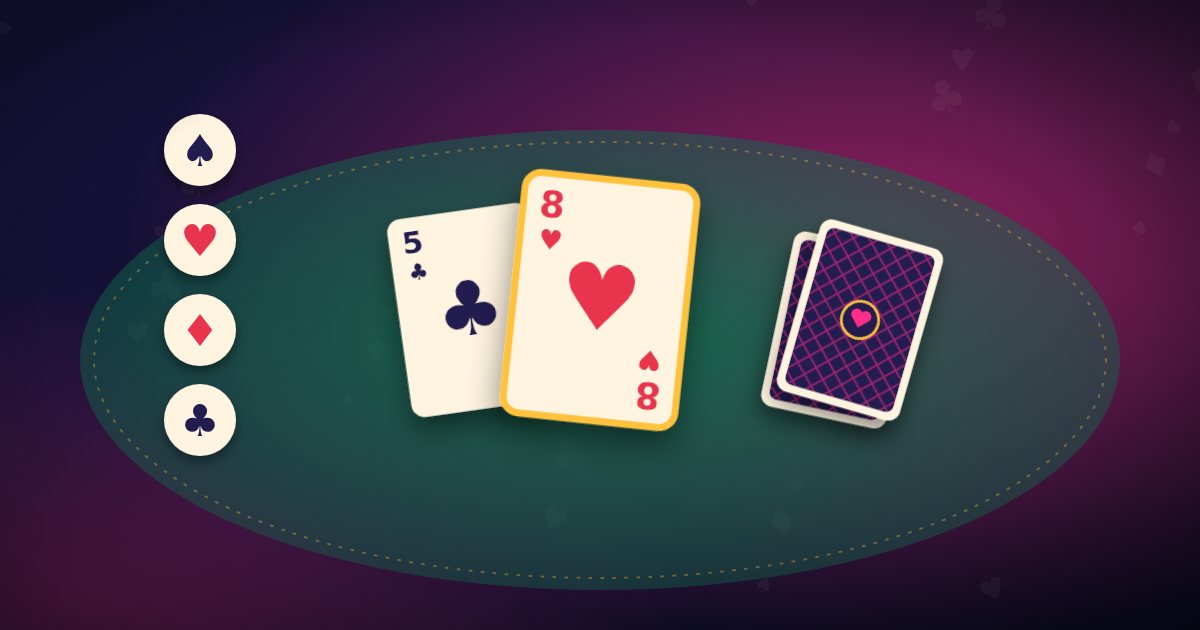
Starting with the player to the dealer's left, each player either passes or tells the dealer to pick up the face-up card, which makes its suit trumps.
- An opponent of the dealer says "I order it up."
- The dealer's partner traditionally says "I assist."
- The dealer can pick it up themselves.
If someone orders it up, the dealer adds the card to their hand and discards one card face down. The team that chose trumps becomes the makers.
Round two: naming trumps
If all four pass, the dealer turns the card face down. Starting again to the dealer's left, each player may now name any other suit as trumps, or pass. The turned-down suit can't be chosen.
If all four pass again, the cards are thrown in and the deal moves to the next player.
Going alone
When choosing trumps, the maker may announce they're going alone. Their partner places their cards face down and sits out the hand. Win all five tricks alone and you score big (see below).
How a hand is played
- The player to the dealer's left leads the first trick. If that player's partner is going alone, many tables let the next player lead instead.
- Everyone must follow suit if they can. Remember the left bower belongs to the trump suit.
- If you can't follow, you may play any card, including a trump.
- The highest trump wins the trick; if no trump was played, the highest card of the suit led wins.
- The winner leads to the next trick. Five tricks make a hand.
Scoring
| Result | Points |
|---|---|
| Makers win 3 or 4 tricks | 1 to makers |
| Makers win all 5 tricks (a "march") | 2 to makers |
| Lone player wins 3 or 4 tricks | 1 to makers |
| Lone player wins all 5 tricks | 4 to makers |
| Makers win fewer than 3 tricks (euchred) | 2 to defenders |
The first team to 10 points wins the game.
Common variations
- Stick the dealer: a very common rule. If everyone passes in round two, the dealer must name trumps instead of throwing the hand in. It speeds the game up and puts pressure on the dealer.
- Defending alone: some tables let a defender go alone against a lone maker, with a bonus (often 4 points) for euchring them.
- Farmer's hand: in some areas, a player dealt only 9s and 10s may swap cards with the kitty or call a re-deal.
- The joker or "benny": some versions add a joker as the highest trump of all.
- Different deck sizes: a few groups play with a 32-card deck (adding 7s and 8s) or a 25-card deck with a joker.
Rules differ from region to region, so agree on them before the first deal.
Strategy tips
- Count your trumps, including the left bower. Three trumps, especially with a bower, is usually a strong hand to call.
- Think about the dealer's pick-up. Ordering up gives the dealer an extra trump. Ordering it up to your opponent's dealer needs a stronger hand than assisting your own partner.
- Lead trumps when your partner made it. It pulls out the opponents' trumps and protects your partner's winners.
- Don't lead trumps into a maker on defence unless you have a clear reason. Lead an off-suit ace instead.
- Go alone with a near-certain hand, such as both bowers plus the ace of trumps and a side ace.
- Remember next and reverse next. When the turned card is passed, players often name the other suit of the same colour ("next"), because the left bower comes from that suit.
Common mistakes
- Following suit with the left bower as its printed suit. It's a trump, so if hearts are trumps and diamonds are led, you can't play the J♦ as a diamond.
- Naming the turned-down suit in round two.
- Forgetting the dealer must discard after picking up.
- Scoring a march as 1 point. Winning all five tricks is worth 2, or 4 when alone.
Euchre and other trick-taking games
Euchre is a short, punchy trick-taking game for four. If you like it, try Spades for bidding in partnerships, or Hearts where you avoid tricks instead. Our guide to card games for 4 players has more. For regional variants, see the Wikipedia euchre article.
Play trick-taking games offline
The same trick-taking skills carry straight over to Card Adda, which offers 16 card games in one app, including Spades, Callbreak, 29, Hazari and Hearts, all playable offline against computer players.
FAQ
What is the left bower in euchre?
It's the jack of the same colour as trumps. It ranks as the second-highest trump and counts as a trump for all purposes.
How many cards do you deal in euchre?
Each player gets five cards, usually dealt in packets of two and three. The remaining four cards form the kitty.
What happens if everyone passes in euchre?
In standard rules, the hand is thrown in and the next player deals. With the common "stick the dealer" rule, the dealer must name trumps.
How many points is going alone in euchre?
If a lone player wins all five tricks, their team scores 4 points. Winning three or four tricks alone scores 1.
How many points do you need to win euchre?
The standard game is played to 10 points.
Card Adda
16 card games in one app: Spades, Callbreak, 29, Hazari and more. Free, offline, on Android.