War Card Game Rules: How to Play War, Ties and Fun Variations
War card game rules explained: dealing, flipping, what happens in a war, running out of cards, how to win, and fun variations for 3 or more players and kids.
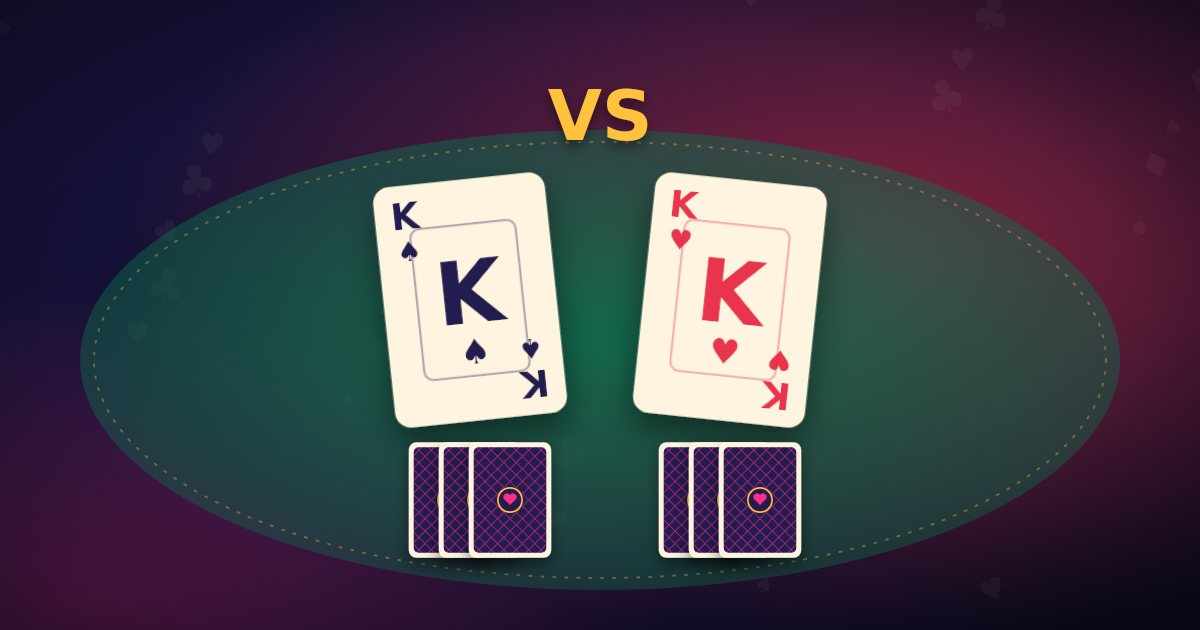
War card game rules are about as simple as card games get: split the deck between two players, both flip their top card at the same time, and the higher card wins both. When the cards tie, you go to "war" for a bigger pile. Whoever ends up with all 52 cards wins.
There are no decisions to make, which is exactly why War is a favourite first card game for children and a fun way to pass time anywhere. Here's how to deal, what to do in a war, the common house rules, and some variations that add a bit more spice.
Objective
Win all the cards. Every time your card beats your opponent's, you collect both. The game ends when one player holds the whole deck, or when you agree to stop and count cards.
Setup: what you need
- 2 players (variations for more below).
- A standard 52-card deck, no jokers.
- Shuffle and deal the whole deck face down, one at a time, so each player has 26 cards.
- Each player keeps their cards in a face-down pile and doesn't look at them.
Card ranking
Aces are high. Suits don't matter.
| Rank order (high to low) |
|---|
| A, K, Q, J, 10, 9, 8, 7, 6, 5, 4, 3, 2 |
| Setup at a glance | |
|---|---|
| Players | 2 (3 or 4 with variations) |
| Deck | 52 cards |
| Cards each | 26 |
| Highest card | Ace |
| Suits ranked? | No |
| Skill needed | None; pure luck |
How a turn works
- Both players turn over their top card at the same time and place it face up in the middle. This is called a battle.
- The higher card wins. That player takes both cards and puts them face down at the bottom of their pile.
- Keep going, battle after battle.
What happens when there's a tie: going to war
If both cards are the same rank, say two queens, it's war.
- Each player places three cards face down in the middle.
- Then each player turns one more card face up.
- The higher face-up card wins the entire pile: both original cards, all the face-down cards and both new face-up cards. That's 10 cards.
- If the new face-up cards tie again, repeat the war: three more down, one more up, until someone wins.
Many families play with one card face down instead of three, which makes wars quicker. Others say "I de-clare war" out loud and place one card per syllable. All of these are fine; just agree before you start.
Running out of cards during a war
This is the most common argument in War, and house rules really do differ. The usual options are:
- You lose. If you don't have enough cards to finish a war, you lose the game.
- Play your last card face up. If you run short, your final card becomes your face-up card for the war.
Pick one before you begin to save any disputes.
Scoring and winning
There are no points in classic War. You win by collecting all 52 cards.
Because a full game can go on for a long time, lots of players use a shortcut:
- Time limit: play for 10 or 15 minutes, then count. Most cards wins.
- Single pass: play through your pile once without picking up the won cards; whoever has won more cards at the end wins.
- First to a target: first player to win, say, three wars wins.
Variations
| Variation | How it works |
|---|---|
| War for 3 players | Deal 17 cards each (leave one card out, or deal it face up as a bonus for the first battle winner). Highest card wins all three; a tie between the top two cards means only those players go to war. |
| War for 4 players | Deal 13 each and play the same way, or play as two teams. |
| Peace | The opposite of War: the lowest card wins. In a tie ("peace"), players deal out the letters of P-E-A-C-E. |
| Addition War | Each player flips two cards and adds them up; the higher total wins. Great for practising sums. Count J as 11, Q as 12, K as 13 and A as 1, or agree your own values. |
| Multiplication War | Same idea, but multiply the two cards. Ideal for times-tables practice. |
| Joker War | Add the jokers as the highest cards in the deck. |
| Shuffle on pickup | Shuffle your winnings before adding them to your pile. This stops games from looping for ages. |
Tips to keep War fun
War has no real strategy, since you never choose which card to play. But a few small choices help the game run better.
- Shuffle well before dealing. A badly shuffled deck can make games drag. Our guide on how to shuffle cards explains the basics.
- Agree house rules first: cards down in a war, what happens if someone runs out, and whether there's a time limit.
- Use a time limit with young children so the game ends before attention runs out.
- Try a maths variation to turn War into a learning game.
- Collect cards in a tidy order. Some players put the winning card on the bottom first; it doesn't matter as long as you're consistent.
Common mistakes
- Looking at your cards. Your pile stays face down; the surprise is the whole point.
- Forgetting the face-down cards in a war. The winner takes the whole pile, not just the face-up cards.
- Treating suits as a tie-breaker. In standard War, suits don't count.
- Not agreeing the out-of-cards rule before a big war decides the game.
Where to go next
War is a perfect stepping stone to games with real choices. For quick two-player ideas, see card games for 2 players, and for family-friendly picks, try our guide to card games for kids. The War article on Wikipedia) also covers regional versions.
Play card games offline
When you're ready for games where your choices matter, trick-taking games are the natural next step: you still win by playing the higher card, but now you choose which card to play. Card Adda brings 16 card games together in one app, including Spades, Callbreak, 29, Hazari and Hearts, all playable offline against computer players.
FAQ
What happens if you tie in War?
You go to war: each player puts three cards face down (one in some house rules) and then one face up. The higher face-up card wins every card in the pile.
Is the ace high or low in War?
The ace is the highest card in standard War. Some families play with ace low, so agree before you start.
What happens if you run out of cards during a war?
It depends on house rules. Usually you either lose the game or play your last card as your face-up card.
Can 3 people play War?
Yes. Deal 17 cards each and play the same way; if two players tie for the highest card, only those two go to war.
How long does a game of War last?
It varies a lot, and a full game can take a long time. Many players set a time limit and count cards at the end.
Card Adda
16 card games in one app: Spades, Callbreak, 29, Hazari and more. Free, offline, on Android.