Gin Rummy Rules: Deadwood, Knocking, Gin and Scoring to 100
Gin Rummy rules for two players: the deal, melds and deadwood, when you can knock, gin and undercut bonuses, laying off, and how to score a game to 100 points.
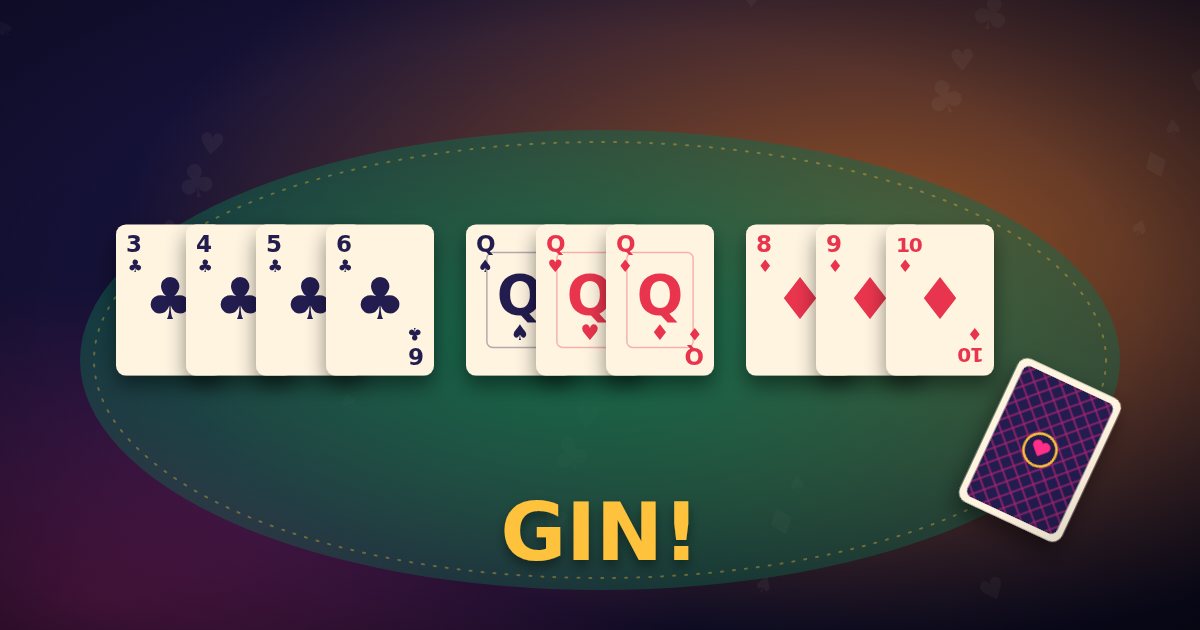
The Gin Rummy rules in a nutshell: two players each hold 10 cards, draw and discard to form melds (sets and runs), and try to reduce their unmatched cards, called deadwood. When your deadwood totals 10 points or less, you can knock to end the hand. Match every card and you've gone gin, which earns a 25-point bonus.
It's one of the great two-player card games: quick to learn, with plenty of skill in reading what your opponent is collecting. Here's how to play, score and win.
Objective
Score 100 points before your opponent. You earn points by ending a hand with less deadwood than your opponent, by going gin, or by catching your opponent with an undercut when they knock.
Setup: what you need
| Item | Standard practice |
|---|---|
| Players | 2 |
| Deck | Standard 52-card deck, no jokers |
| Card order | Ace low: A-2-3…J-Q-K |
| Cards each | 10 |
| Stock | Remaining cards face down |
| Upcard | Top card of the stock turned face up to start the discard pile |
Card values for deadwood
| Card | Points |
|---|---|
| King, queen, jack | 10 |
| 10 down to 2 | Face value |
| Ace | 1 |
Melds and deadwood
A meld is either a set of 3 or 4 cards of the same rank (7♠ 7♥ 7♣) or a run of 3 or more consecutive cards in one suit (9♦ 10♦ J♦). Aces are low only, so A-2-3 is a run but Q-K-A is not.
Deadwood is every card not in a meld. Each card can only belong to one meld at a time, so if you hold 7♠ 7♥ 7♣ 8♣ 9♣, you must decide whether the 7♣ goes in the set or the run.
Unlike standard Rummy, you don't lay melds on the table during play. Everything stays in your hand until the hand ends.
How a turn works
The first turn
- The non-dealer may take the upcard.
- If they decline, the dealer may take it.
- If both decline, the non-dealer draws the top card of the stock and play continues normally.
Every turn after that
- Draw one card, from the stock or the top of the discard pile.
- Discard one card face up, leaving 10 in your hand.
You can't pick up the top discard and throw the same card back on the same turn.
Knocking
After drawing, if your deadwood totals 10 or less, you may knock: discard one card face down and lay out your hand, separated into melds and deadwood. You don't have to knock as soon as you're able; waiting for a lower count or gin is often better.
Your opponent then lays out their hand and may lay off deadwood cards onto your melds. For example, if you show 4♥ 5♥ 6♥, they can lay off a 3♥ or 7♥ to reduce their own deadwood.
Going gin
If all 10 cards are melded, you've gone gin. Your opponent can't lay off on your melds, and you can't be undercut.
If the stock runs low
When only two cards remain in the stock and the player who drew doesn't knock, the hand is usually declared a draw with no score, and the same dealer deals again.
Scoring
| Result | Points to the winner of the hand |
|---|---|
| Knock, knocker has less deadwood | Difference in deadwood |
| Gin | 25 bonus + opponent's deadwood |
| Undercut (defender's deadwood equal to or less than the knocker's) | 25 bonus + difference in deadwood, to the defender |
Example: you knock with 6 deadwood, and after laying off your opponent has 21. You score 15. If they'd got down to 6 or less, they'd score the undercut instead.
The first player to reach 100 points wins the game.
Common end-of-game bonuses
Many players add these when the game ends. They're widespread but not universal, so agree them first:
- Line or box bonus: 25 points for each hand won.
- Game bonus: 100 points for winning the game.
- Shutout (or "blitz"): if the loser scored nothing at all, the winner's total is doubled.
Variations
- Undercut bonus: standard is 25, but some players use 10 or 20.
- Big Gin: going gin with all 11 cards after drawing, without discarding. It earns a bigger bonus than standard gin, commonly 31 or 50 points.
- Oklahoma Gin: the first upcard sets the maximum deadwood for knocking in that hand. A spade upcard often doubles the hand's score.
- Three-player Gin: the dealer sits out each hand and the other two play.
Gin Rummy strategy tips
- Discard high deadwood early. Kings and queens are 10 points each if your opponent knocks.
- Track the discard pile. Cards your opponent picks up tell you which ranks and suits they're building; avoid feeding them.
- Don't take the discard just because it fits. Picking up reveals your plans. Draw from the stock when the gain is small.
- Knock early when you can. Knocking with a low count in the first few turns often catches your opponent holding plenty of deadwood.
- Beware the undercut. Late in a hand, your opponent's deadwood may be low. Wait for gin, or knock with a smaller count.
- Keep flexible cards. A 6♦ next to 5♦ and 6♠ can grow into either a run or a set.
Common mistakes
- Counting a card in two melds at once.
- Laying off on a gin hand (not allowed).
- Knocking with 10 deadwood late in the hand and getting undercut.
- Forgetting the ace is low, so Q-K-A isn't a run.
Related guides
Gin Rummy is a two-player version of the wider Rummy family. Start with how to play Rummy if you're new, or compare it with 13 card rummy rules. For more two-handed games, see our list of card games for 2 players. The Gin Rummy page on pagat.com covers further variants in detail.
Play card games offline
If you enjoy card games built on memory and reading your opponent, the same skills carry over to trick-taking games. Card Adda has 16 card games in one app, including Spades, Callbreak, 29, Hazari and Hearts, all playable offline against computer players.
FAQ
What is deadwood in Gin Rummy?
Deadwood is any card in your hand that isn't part of a set or run. Face cards count 10, aces 1 and other cards their face value.
When can you knock in Gin Rummy?
You can knock once your deadwood totals 10 points or less. You discard face down and lay out your hand, and your opponent can then lay off cards on your melds.
How many points is gin in Gin Rummy?
Going gin earns a 25-point bonus plus the value of your opponent's deadwood. Your opponent can't lay off cards against a gin hand.
What is an undercut in Gin Rummy?
An undercut happens when the defending player's deadwood is equal to or lower than the knocker's. The defender scores the difference plus a bonus, usually 25 points.
How many points do you play to in Gin Rummy?
The standard game is played to 100 points, often with extra bonuses for each hand won and for winning the game.
Card Adda
16 card games in one app: Spades, Callbreak, 29, Hazari and more. Free, offline, on Android.