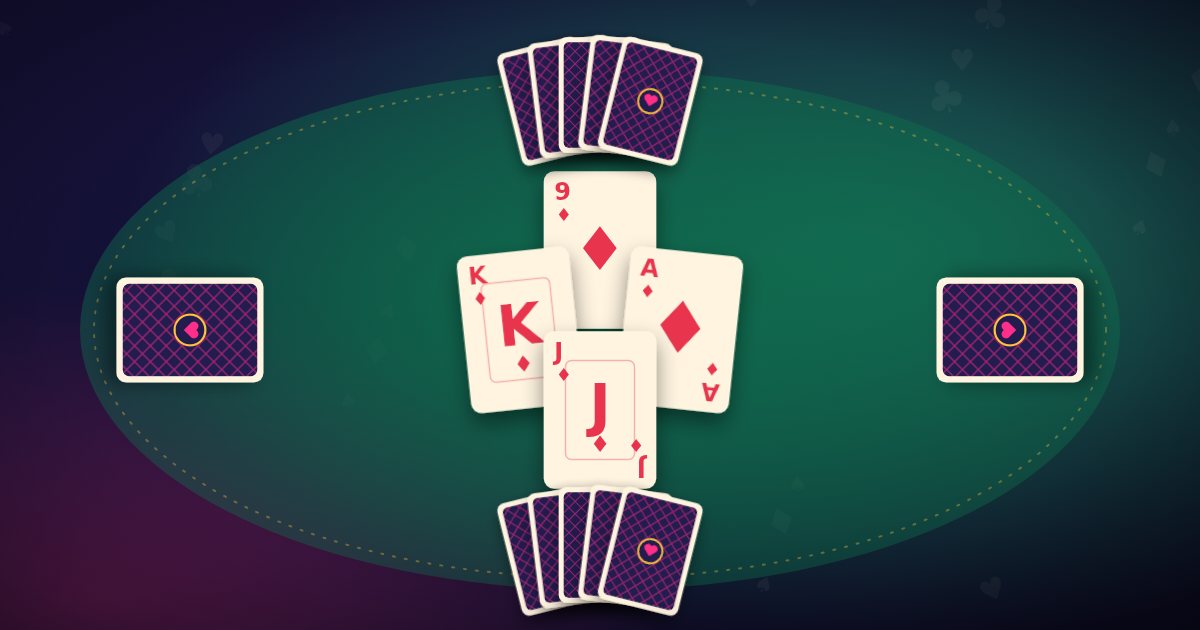
How to Play Bridge: A Beginner's Guide to Contract Bridge
Learn how to play bridge: partnerships, the auction, contracts, trumps and no-trump, the dummy, scoring and simple beginner bidding with high card points.
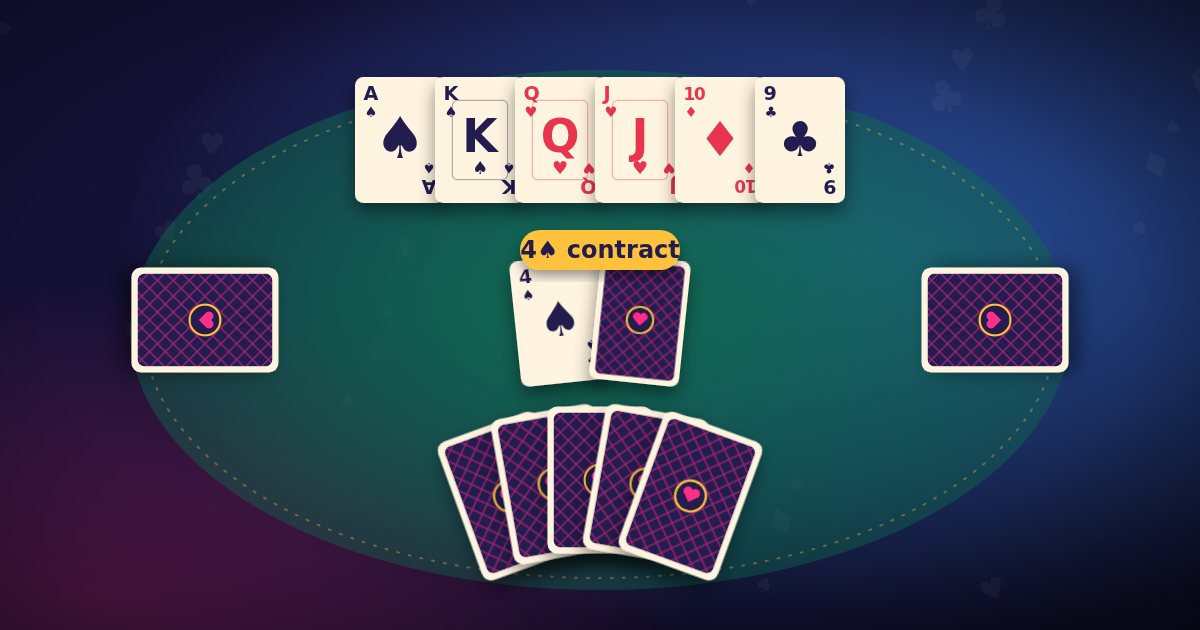
How to play bridge comes down to two stages. First, the four players hold an auction to decide how many tricks one partnership promises to win and which suit (if any) will be trumps. Then they play the cards to see whether that promise, the contract, is kept.
Contract bridge has a reputation for being hard, but the basics are learnable in an evening. If you've played Spades or Callbreak, you already know trick-taking. Bridge adds a richer auction and one unique twist: the dummy.
Objective
Each partnership wants to score points by making contracts it bids and by defeating contracts the opponents bid. The real skill is in bidding the right contract: high enough to earn big bonuses, but not so high that you fail.
What you need
| Item | Detail |
|---|---|
| Players | 4, in 2 fixed partnerships |
| Seating | Partners opposite: North–South vs. East–West |
| Deck | Standard 52 cards, no jokers |
| Card ranking | A (high), K, Q, J, 10 … 2 |
| Hand size | 13 cards each |
| Tricks per deal | 13 |
The dealer deals all 52 cards one at a time, clockwise, starting with the player on their left. The deal rotates clockwise after each hand.
The auction (bidding)
Starting with the dealer and going clockwise, each player makes one call: a bid, a pass, a double or a redouble.
What a bid means
A bid has a level (1 to 7) and a strain (a suit or no-trump). The level is the number of tricks you promise above six. The first six tricks are called the book.
- 1♥ = win at least 7 tricks with hearts as trumps.
- 4♠ = win at least 10 tricks with spades as trumps.
- 3NT = win at least 9 tricks with no trump suit.
- 7NT = win all 13 tricks with no trumps.
Ranking the strains
Each new bid must be higher than the last: either a higher level, or the same level in a higher-ranking strain.
Clubs (lowest) → diamonds → hearts → spades → no-trump (highest)
So after 1♥, you could bid 1♠ or 1NT, but to show clubs you'd need 2♣.
Pass, double and redouble
- Pass: you don't want to bid this turn.
- Double: made on an opponent's bid. It increases the scores (and the penalties) if that contract becomes final.
- Redouble: made by the doubled side to raise the stakes again.
Ending the auction
The auction ends when a bid, double or redouble is followed by three passes in a row. The last bid is the contract. If all four players pass at the start, the hand is thrown in and re-dealt.
The declarer is the player in the winning partnership who first named the strain of the final contract. Their partner becomes the dummy.
How the play works
- The player to the declarer's left makes the opening lead.
- The dummy then lays all 13 cards face up on the table, sorted into suits, with trumps (if any) on dummy's right.
- The declarer plays both hands: their own and the dummy's. The dummy's player takes no part in the play.
- Everyone must follow suit if they can. If you can't, you may play any card, including a trump.
- The trick is won by the highest trump, or if no trump was played, the highest card of the suit led.
- The winner of each trick leads to the next one.
In a no-trump contract, there are no trumps at all: the highest card in the suit led always wins.
Scoring overview
Bridge scoring looks intimidating, but the core is simple. Here are the standard values for contract points, earned for each trick bid and made beyond the book of six.
| Strain | Points per trick (undoubled) |
|---|---|
| Clubs ♣ / Diamonds ♦ (minors) | 20 |
| Hearts ♥ / Spades ♠ (majors) | 30 |
| No-trump | 40 for the first trick, 30 for each after |
Game, part-score and slams
A contract worth 100 or more contract points is a game. That means the cheapest game contracts are:
- 3NT (40 + 30 + 30 = 100)
- 4♥ or 4♠ (4 × 30 = 120)
- 5♣ or 5♦ (5 × 20 = 100)
Anything less is a part-score. Bigger bonuses go to slams.
| Bonus | Not vulnerable | Vulnerable |
|---|---|---|
| Small slam (bid and make 12 tricks) | 500 | 750 |
| Grand slam (bid and make all 13) | 1,000 | 1,500 |
| Game bonus (duplicate scoring) | 300 | 500 |
| Part-score bonus (duplicate scoring) | 50 | 50 |
| Each undertrick, undoubled | 50 | 100 |
Vulnerability raises both bonuses and penalties. In rubber bridge you become vulnerable after winning a game; in duplicate it's set for each board.
In rubber bridge, the first side to win two games wins the rubber and a bonus (700 if the opponents won no game, 500 if they won one). In duplicate bridge, the same deals are played at several tables and you're compared with others holding the same cards. Doubled contracts and overtricks have their own tables; you can learn those once the basics feel natural.
Beginner bidding: high card points
Most beginners learn to value their hands with high card points (HCP):
| Card | Points |
|---|---|
| Ace | 4 |
| King | 3 |
| Queen | 2 |
| Jack | 1 |
There are 40 HCP in the deck, so an average hand has 10.
Simple guidelines from widely taught systems such as Standard American:
- Open the bidding with 12 or more HCP. With fewer, usually pass.
- Open 1NT with 15–17 HCP and a balanced hand (no void, no singleton, at most one doubleton).
- Open 1♥ or 1♠ with five or more cards in that suit; otherwise open your longer minor.
- Respond with 6 or more HCP when partner opens.
- Look for an eight-card trump fit between you and partner, ideally in a major.
- Count your combined points. Around 25 usually means you can bid game, and around 33 points towards a small slam.
These are guidelines, not laws. Shape, long suits and partnership agreements all matter.
Strategy tips for new players
- Plan before you play to trick one. As declarer, count your sure winners and work out where extra tricks will come from.
- Draw trumps early in a suit contract, unless you need them to ruff losers in dummy.
- Lead the top of a sequence on defence, such as the king from K-Q-J.
- Talk only through bids. Partners communicate solely with legal calls and plays, never with hints or table talk.
- Don't overbid to catch up. Going down doubled and vulnerable can cost far more than a part-score.
Common mistakes
- Forgetting the book. A 2♠ bid means 8 tricks, not 2.
- Playing dummy's cards for them as dummy. The declarer calls every card from dummy.
- Bidding a suit lower than the last bid without raising the level.
- Ignoring vulnerability when deciding whether to compete.
Contract Bridge vs. Call Bridge
If you're from Bangladesh or India, you might know Call Bridge. Despite the name, it's a different, much simpler South Asian game. Players usually play for themselves, spades are always trumps, and each player simply calls how many tricks they'll win. There's no auction for the trump suit and no dummy. Local rules vary, and it's a close cousin of Callbreak; see our guide to popular card games in Bangladesh. For full Contract Bridge laws and history, the Wikipedia contract bridge article is a solid reference.
Play Call Bridge offline
If you enjoy calling and trick-taking, Card Hero has Call Bridge alongside Callbreak, 29, Hazari, Hearts and 9 Cards, all playable offline against computer players.
FAQ
Is bridge hard to learn?
The rules of play can be learned in an evening. Bidding well takes longer, but beginners can enjoy the game quickly with simple point-count guidelines.
How many points do you need to open in bridge?
Most beginner systems open the bidding with 12 or more high card points, counting ace 4, king 3, queen 2 and jack 1.
What is the dummy in bridge?
The dummy is the declarer's partner. After the opening lead, dummy's cards are laid face up and the declarer plays them.
How many tricks do you need to make game in bridge?
You need 9 tricks in no-trump (3NT), 10 in hearts or spades (4♥ or 4♠) and 11 in clubs or diamonds (5♣ or 5♦).
What is the difference between Call Bridge and Contract Bridge?
Contract Bridge is a partnership game with an auction, a dummy and a chosen trump suit. Call Bridge is a simpler South Asian game, usually played individually, where spades are always trumps and players call how many tricks they'll take.
Card Hero
29, Hazari, Callbreak, Call Bridge, Hearts and 9 Cards. Free, offline, on Android.