The History of Ludo: From Pachisi in Mughal India to Your Phone
Where does Ludo come from? The story of Pachisi in ancient India, Emperor Akbar's life-size board, cowrie shells, Ludo's 1896 arrival in England, and today's mobile boom.
Ludo feels timeless because it nearly is. The game millions play on their phones descends from Pachisi, a race game played in India for well over a thousand years. Here's how a royal court game became the world's favourite family board game.
Pachisi: the ancestor
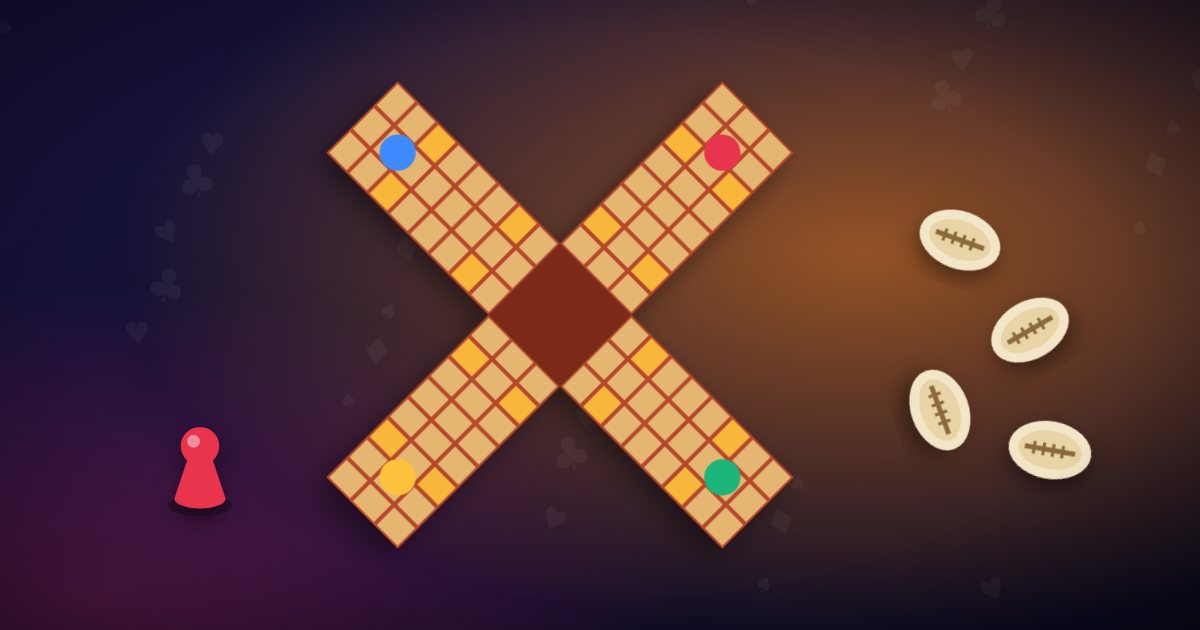
Pachisi comes from the Hindi word pachchis, meaning twenty-five, the highest throw in the game. It's a cross-and-circle race game: the board is shaped like a cross, and players move their pieces around it and back to the centre.
Instead of dice, Pachisi traditionally uses six cowrie shells. You throw them and count how many land with the opening facing up; that decides how far you move. A related game called pasha appears in the epic Mahabharata, where a fateful game of dice changes the story (Wikipedia: Pachisi).
Akbar's life-size board
The most famous Pachisi players were Mughal royalty. Emperor Akbar is said to have played on a giant board laid out in a palace courtyard, with people dressed in coloured clothes as the pieces, moving square to square at every throw. Traces of such courtyard boards are still pointed out to visitors at Fatehpur Sikri near Agra.
Ludo arrives in England (1896)
In the 19th century, British travellers brought Pachisi home. Game makers simplified it: a square board, a single cube die and a dice cup. In 1896 it was marketed in England as "Ludo", Latin for "I play" (Wikipedia: Ludo).
The Royal Navy even developed its own rougher version, Uckers, which is still played aboard ships.
Ludo's cousins around the world
| Game | Where | Twist |
|---|---|---|
| Pachisi | India | Cowrie shells, cross-shaped cloth board |
| Chaupar | India | Long dice instead of shells |
| Ludo | UK, South Asia, Africa | Single die, square board |
| Parcheesi | USA | Two dice, blockades |
| Parchís | Spain | Bonus moves for captures and getting home |
| Mensch ärgere Dich nicht | Germany | "Don't get angry, man!" |
| Sorry! | USA | Uses cards instead of dice |
From board to phone
Ludo's simple rules made it perfect for mobile. During 2020 especially, it became a way for families and friends to play together while apart. Today it's one of the most-played casual games in South Asia, often on budget phones and patchy connections, which is why offline Ludo matters.
Pachisi vs Ludo: the key differences
- Randomiser: cowrie shells (Pachisi) vs a single die (Ludo).
- Board: a cross-shaped cloth vs a square board with a cross track.
- Speed: Pachisi games are longer; Ludo was streamlined for families.
- Teams: Pachisi is often played in partnerships; Ludo is usually every player for themselves.
Play the modern version
Learn the complete Ludo rules and 9 tips to win, then play against the computer in Board Adda: Ludo Carrom Chess, free and offline.
FAQ
Where did Ludo originate?
Ludo comes from Pachisi, an ancient race game from India.
When was Ludo invented?
The modern version was marketed as "Ludo" in England in 1896, based on the Indian game Pachisi.
What does Pachisi mean?
It comes from the Hindi word for twenty-five, the highest score you can throw with the cowrie shells.
What is the difference between Ludo and Pachisi?
Pachisi uses cowrie shells and a cross-shaped board and is often played in teams; Ludo uses a single die and a square board.
Board Adda: Ludo Carrom Chess
Ludo, carrom, chess and 10 more board games. Free, offline, on Android.