How to Win Tic Tac Toe: Best First Move, Forks and Never Losing
How to win tic tac toe every time you can: the best opening move, how to set up a fork, and the exact replies that mean you never lose as O.
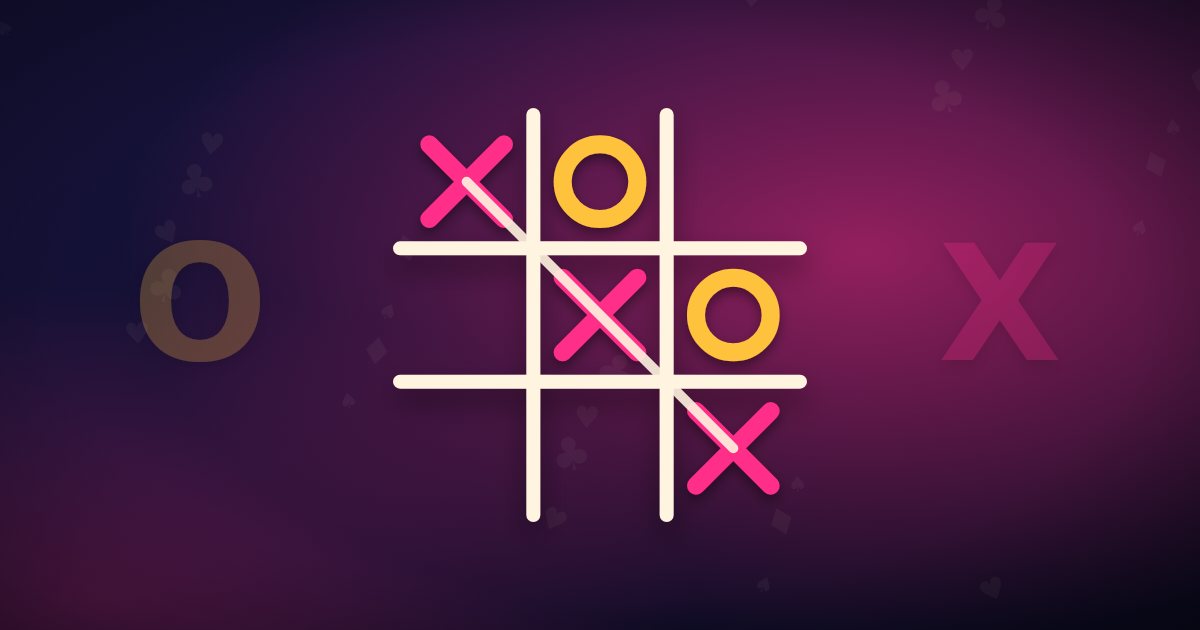
Here's the honest answer to how to win tic tac toe: against a perfect opponent, you can't. With best play from both sides, every game ends in a draw. But most opponents aren't perfect. Start in a corner, aim for a fork (two threats at once), and you'll win a lot of games. Play the right replies as O and you'll never lose.
Below are the rules in brief, then the exact moves that win games and save them.
Objective
Get three of your marks in a row: across, down or diagonally. If all nine squares fill up and nobody has a line, the game is a draw (sometimes called a "cat's game").
Setup: what you need
| Item | Detail |
|---|---|
| Players | 2 |
| Board | 3×3 grid, 9 squares |
| Marks | One player is X, the other O |
| First move | X traditionally goes first |
| Winning lines | 8 in total: 3 rows, 3 columns, 2 diagonals |
To keep things clear, we'll name the squares like this:
| Left column | Middle column | Right column |
|---|---|---|
| Top-left corner | Top edge | Top-right corner |
| Left edge | Centre | Right edge |
| Bottom-left corner | Bottom edge | Bottom-right corner |
How a turn works
- Players take turns placing one mark in any empty square.
- You can't move or remove a mark once it's placed.
- The first player to complete a line of three wins immediately.
The priority list for every move
Before each move, run through this list in order. It's the backbone of perfect play.
- Win: if you have two in a line and the third square is empty, take it.
- Block: if your opponent has two in a line, block the third square.
- Fork: make a move that creates two winning threats at once.
- Block a fork: stop your opponent from creating two threats.
- Centre: take it if it's free.
- Opposite corner: if your opponent is in a corner, take the corner opposite.
- Empty corner.
- Empty edge.
Forks: how games are actually won
A fork is a move that makes two lines of two at the same time. Your opponent can block only one, so you win with the other. Almost every tic-tac-toe win against a reasonable player comes from a fork.
A classic example: X holds the top-left and bottom-right corners; O holds the centre and the top-right corner. O is threatening the diagonal, so X blocks in the bottom-left corner. That block also makes two lines at once, down the left side and along the bottom. O can stop only one, and X wins.
How to win as X
Start in a corner
X can open anywhere and still draw with perfect play, but a corner gives O the most ways to go wrong. Against a corner opening, O's only safe reply is the centre. Any other reply, including the opposite corner or any edge, lets X force a win.
So if O doesn't take the centre, set up a fork:
- O plays an edge: take another corner so that your two corners line up with an empty square between them, forcing O to block. Then place your third mark to create two threats at once.
- O plays a corner: take a third corner. O must block the line between your corners, and your next move makes a fork.
When O does take the centre
Take the opposite corner (if you opened top-left, take bottom-right). Now O must reply on an edge. If O takes a corner instead, you get a fork and win. If O plays an edge, block sensibly and the game will be a draw.
Starting in the centre
The centre is also a strong start. O must reply in a corner; an edge reply loses to a fork. After a corner reply, perfect play leads to a draw.
How to never lose as O
Use these replies and no opponent can beat you:
| X's first move | Your safe reply as O | Replies that lose |
|---|---|---|
| Corner | Centre (the only safe move) | Any edge or corner |
| Centre | Any corner | Any edge |
| Edge | Centre, a corner next to X, or the opposite edge | The two far corners or the other two edges |
The trap to remember
If X opens in a corner, you take the centre, and X takes the opposite corner, you must play an edge, not a corner. It feels backwards, but a corner here walks straight into a fork. After that, keep following the priority list: win, block, block forks.
Variations
- Ultimate tic-tac-toe: nine small boards inside one big board. Where you play on the small board decides which board your opponent must play in next. Far deeper than the original.
- Bigger boards: 4×4 or larger grids, often needing four or five in a row. Gomoku (five in a row on a large board) is a famous relative.
- Misère (reverse) tic-tac-toe: whoever makes three in a row loses.
- Three Men's Morris style: each player has only three marks and must move one once all are placed, so the game can't end in a full-board draw.
Strategy tips
- Always check for a win before a block. Taking your own win ends the game; blocking only delays.
- Corners are worth more than edges. A corner sits on three lines; an edge sits on only two. The centre sits on four.
- Think one move ahead for forks. Before every move, ask: "Can my opponent make two threats next turn?"
- Force your opponent's moves. Making two in a row forces a block, which lets you choose where their mark goes.
- Mix up your openings against the same person so they can't memorise one defence.
Common mistakes
- Taking an edge after a corner opening as O. That loses against correct play.
- Taking a corner after corner–centre–opposite corner as O. You must take an edge.
- Blocking when you could win. Always look for your own three first.
- Ignoring a developing fork until it's too late to stop.
Love strategy games? Play offline
Tic-tac-toe is a perfect first strategy game, and once it always ends in a draw, it's time for something deeper. Board Adda: Ludo Carrom Chess has 13 classic board games, including checkers and chess, all playable offline. Checkers is the natural next step: the same "force your opponent's move" thinking you use for forks drives its tactics. Learn the basics in our checkers rules guide, then move on to chess rules for beginners.
FAQ
Is there a way to always win tic-tac-toe?
No. If both players make the best moves, every game is a draw. You can only win when your opponent makes a mistake, which is why setting up forks matters.
What is the best first move in tic-tac-toe?
A corner is usually the best practical choice, because O has only one safe reply (the centre). The centre is also a strong opening.
How do you never lose at tic-tac-toe?
Follow the priority order: win, block, make a fork, block a fork. As O, answer a corner with the centre and a centre with a corner.
Who has the advantage in tic-tac-toe?
X, who moves first, has more chances to set traps, but perfect play from O always holds the draw.
Board Adda: Ludo Carrom Chess
Ludo, carrom, chess and 10 more board games. Free, offline, on Android.