Backgammon Rules: Setup, Moves, Bearing Off and the Doubling Cube
Backgammon rules explained step by step: the 2-5-3-5 setup, moving checkers, doubles, hitting and the bar, bearing off, the doubling cube and gammons.
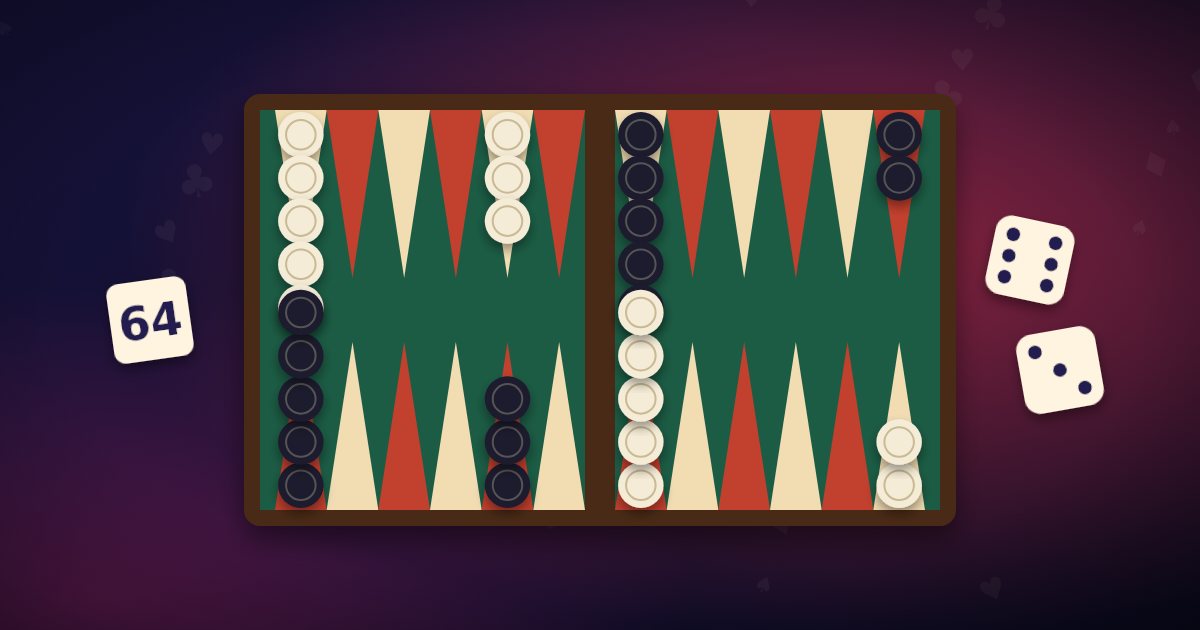
The core backgammon rules are simple: each player races 15 checkers around the board in opposite directions, moving by the roll of two dice, and the first to bear off (remove) all of their checkers wins. Along the way you can hit a lone opposing checker and send it back to the start.
That mix of dice luck and real decisions is why backgammon has lasted for centuries. This guide covers the correct setup, how to move, hitting and the bar, bearing off, the doubling cube, and how gammons and backgammons score.
Objective
Move all 15 of your checkers into your home board and then bear them all off before your opponent does. Win by a big enough margin and you score double or triple.
What you need
| Item | Detail |
|---|---|
| Board | 24 narrow triangles called points, in four quarters of six |
| Checkers | 15 per player, in two colours |
| Dice | Two dice per player (or one shared pair) |
| Doubling cube | A die marked 2, 4, 8, 16, 32 and 64 |
| Players | 2 |
The board is split by a central divider called the bar. Each player has a home board (also called the inner board) and an outer board. Points are numbered 1 to 24 from each player's own point of view: your 1-point is the corner of your home board, and your 24-point is your opponent's 1-point.
The setup: 2-5-3-5
From your own point of view, place your checkers like this:
| Point | Number of checkers | Location |
|---|---|---|
| 24-point | 2 | Opponent's home board (your furthest point) |
| 13-point (the "midpoint") | 5 | Opponent's outer board |
| 8-point | 3 | Your outer board |
| 6-point | 5 | Your home board |
That's 2 + 5 + 3 + 5 = 15 checkers. Your opponent's setup mirrors yours exactly. You move from your 24-point towards your 1-point; your opponent moves the opposite way around the board.
Starting the game
Each player rolls one die. The higher roll goes first and plays the numbers on both dice as their opening move. If the dice match, both players roll again. After that, players alternate, rolling both of their own dice each turn.
How a turn works
- Roll both dice. Each die is a separate move. A roll of 5 and 3 lets you move one checker 5 points and another 3 points, or one checker 5 then 3 (8 in total).
- You can only land on an open point. A point is open if it's empty, holds your own checkers, or holds just one opposing checker.
- Two or more opposing checkers block a point. You can't land there. When one checker uses both dice, the in-between landing point must also be open.
- Doubles count twice. Rolling double 4s gives you four moves of 4, in any combination of checkers.
- You must use as much of your roll as you legally can. If you can play only one number, play it. If you can play either number but not both, you must play the larger one. If nothing is legal, you lose the turn.
Hitting and the bar
A single checker on a point is called a blot. If your opponent lands on it, your checker is hit and placed on the bar.
- While you have any checker on the bar, you must bring it back in first before making any other move.
- To re-enter, you play it into your opponent's home board, on the point matching a die you rolled (a 3 enters on their 3-point, which is your 22-point).
- If both numbers you roll land on blocked points, you can't enter and lose your whole turn.
Building a wall of blocked points, called a prime, can trap your opponent's checkers completely. Six blocked points in a row can't be jumped at all.
Bearing off
Once all 15 of your checkers are in your home board, you can start bearing off.
- Roll the dice. A 6 removes a checker from your 6-point, a 4 from your 4-point, and so on.
- You may instead use a number to move a checker within your home board.
- If there's no checker on the point rolled, you must move a checker from a higher point if possible.
- If there are no checkers on higher points, you may bear off from the highest occupied point.
- If one of your checkers is hit during bearing off, you must bring it back into play and all the way home before bearing off again.
Scoring: single game, gammon and backgammon
| Result | When it happens | Points |
|---|---|---|
| Single game | Loser has borne off at least one checker | 1 × cube value |
| Gammon | Loser hasn't borne off any checkers | 2 × cube value |
| Backgammon | Loser hasn't borne off any checkers and still has one on the bar or in the winner's home board | 3 × cube value |
The doubling cube
The doubling cube lets you raise the stakes during a game. It starts in the middle at 1.
- Before rolling on your turn, you may offer a double.
- Your opponent either accepts (the game is now worth twice as much, and they take the cube) or declines (they resign and lose the current value).
- Only the player who owns the cube can make the next double, which they can redouble to 4, 8 and so on.
The cube is why backgammon is more than a race. Knowing when to offer and when to accept is one of the game's deepest skills. When played as a family game, many people simply leave it out.
Common variations
- Match play: games are played to a set number of points, such as 5 or 7. The Crawford rule says no doubling is allowed in the first game after one player gets within one point of winning.
- Automatic doubles: if the opening rolls match, the cube is turned to 2. This is an optional rule.
- Beavers: a player who accepts a double may immediately redouble while keeping the cube. Also optional.
- Jacoby rule: in money games, gammons and backgammons only count once the cube has been used.
- Regional games: Turkish tavla and Greek tavli include backgammon and related games played on the same board, often with their own rules.
Strategy tips
- Make points, especially the 5-point. Your own 5-point blocks your opponent and gives you a safe landing spot. Opening with 3-1 (8/5, 6/5) makes it straight away.
- Learn the best openers. 6-1 makes your bar point (13/7, 8/7), and 4-2 makes your 4-point (8/4, 6/4).
- Limit your blots. A lone checker within six points of an opponent's checker is easy to hit.
- Bring your back checkers forward before your opponent builds a prime in front of them.
- Know whether you're racing. If you're ahead in the pip count, play safe and run. If you're behind, keep contact and hope for a hit.
- Don't fear the cube. A common beginner guideline is that you can accept a double if you'll win roughly one game in four or more.
Common mistakes
- Setting up the board mirrored wrongly. Check that each player has 2 checkers on the point furthest from home.
- Moving before re-entering a checker from the bar.
- Bearing off too early, before all 15 checkers are home.
- Using the smaller die when only one number can be played.
More strategy games to try
Love dice games with real decisions? Compare backgammon with Ludo, another race game with captures, or try a pure-skill classic like checkers. For another tile-based classic, see our guide to dominoes rules. For tournament rules, the Wikipedia backgammon article is a good start.
Play classic board games offline
If you enjoy classic two-player board games, Board Adda: Ludo Carrom Chess offers 13 classic board games, including Ludo, chess and checkers, with computer opponents and no internet needed.
FAQ
How do you set up a backgammon board?
From your own side, put 2 checkers on your 24-point, 5 on your 13-point, 3 on your 8-point and 5 on your 6-point. Your opponent mirrors this.
What happens when you roll doubles in backgammon?
You play the number four times instead of twice. For example, double 3s gives you four moves of 3.
Can you bear off if you have a checker on the bar?
No. All 15 of your checkers must be in your home board before you bear off, so a checker on the bar must re-enter and come home first.
What is a gammon in backgammon?
A gammon is a win where your opponent hasn't borne off a single checker. It's worth double the cube value.
Do you have to use both dice in backgammon?
Yes, if you legally can. If only one number can be played, you play it, and if either but not both can be played, you must use the larger one.
Board Adda: Ludo Carrom Chess
Ludo, carrom, chess and 10 more board games. Free, offline, on Android.