Chess Rules for Beginners: How Every Piece Moves
Learn to play chess from scratch: setting up the board, how each piece moves and captures, check and checkmate, and the three special moves every beginner must know.
Chess looks intimidating, but the rules fit on one page. Once you know how the six pieces move and what checkmate means, you can play a full game. This guide takes you from an empty board to your first game, then points you to the tricks that win quick games.
Setting up the board
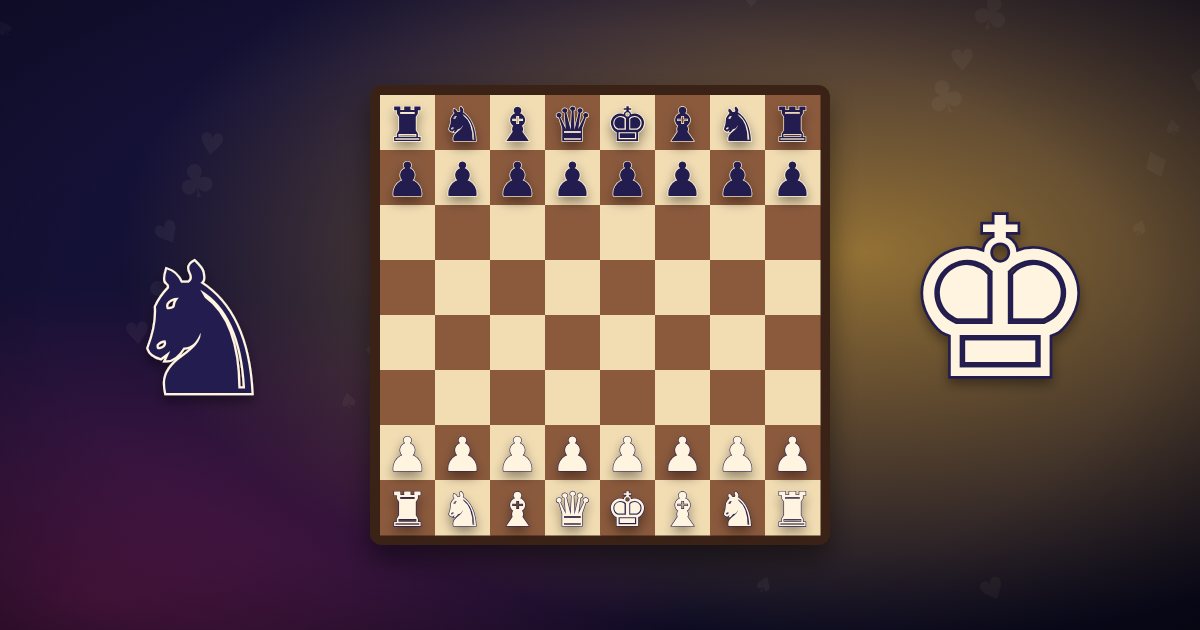
- The board has 64 squares in an 8 × 8 grid. Place it so each player has a light square in the bottom-right corner ("light on right").
- Row 2 (and row 7 for Black): eight pawns.
- Row 1 (and row 8), from the corners inwards: rook, knight, bishop, then the queen and king in the middle.
- Queen on her own colour: the white queen goes on a light square, the black queen on a dark one.
White always moves first, and players then alternate one move at a time.
How each piece moves
| Piece | How it moves | Value |
|---|---|---|
| King | One square in any direction | Priceless |
| Queen | Any number of squares in a straight line or diagonal | 9 |
| Rook | Any number of squares up/down or left/right | 5 |
| Bishop | Any number of squares diagonally (stays on one colour) | 3 |
| Knight | An "L": two squares one way, then one square sideways; it can jump over pieces | 3 |
| Pawn | One square forward (two on its first move); captures one square diagonally forward | 1 |
The values are a rough guide for trading pieces. A rook is usually worth more than a bishop or knight.
Capturing: you capture by moving onto a square occupied by an opponent's piece, which is then removed. Only the knight can jump; every other piece is blocked by pieces in its way.
Check, checkmate and stalemate
- Check: the king is under attack. You must get out of check by moving the king, blocking the attack, or capturing the attacker.
- Checkmate: the king is in check and there's no way out. Checkmate ends the game.
- Stalemate: the player to move is not in check but has no legal move. That's a draw. See our guide to checkmate vs stalemate.
The three special moves
- Castling: the king moves two squares towards a rook and the rook jumps to the other side of it, in one move.
- En passant: a special pawn capture right after an enemy pawn moves two squares past yours.
- Promotion: a pawn reaching the last row becomes a queen (or rook, bishop or knight).
We explain all three, with the conditions, in castling, en passant and promotion explained.
Your first-game checklist
- Control the centre with your e- and d-pawns.
- Develop your knights and bishops before moving the queen.
- Castle early to keep your king safe.
- Before every move, ask: what is my opponent threatening?
- Don't grab "free" pieces without checking for traps. Our article on quick chess traps shows how fast games are lost.
Practise against the computer
The quickest way to learn is to play many short games. Board Adda: Ludo Carrom Chess has chess against the computer, free and offline, so you can practise anywhere. For the full official rules, see Rules of chess on Wikipedia, which summarises the FIDE Laws of Chess.
FAQ
Who moves first in chess?
White always moves first.
How does the knight move?
In an L-shape: two squares in one direction, then one square at a right angle. It's the only piece that can jump over others.
Can the king capture?
Yes. The king can capture an adjacent enemy piece, as long as that square isn't defended.
What happens when a pawn reaches the end of the board?
It must be promoted, usually to a queen, but you can choose a rook, bishop or knight.
Board Adda: Ludo Carrom Chess
Ludo, carrom, chess and 10 more board games. Free, offline, on Android.