Castling, En Passant and Promotion: Chess Special Moves Explained
The three special moves in chess explained simply: when you can and can't castle, how en passant works, and how pawn promotion and underpromotion work.
Most chess moves are simple: pick up a piece and move it the way it's allowed. But three special moves confuse almost every beginner and cause more arguments than anything else in chess. Here they are, explained clearly, with the exact conditions. (For the basics, see chess rules for beginners.)
1. Castling
Castling moves two pieces in one turn: the king and one rook. It tucks your king into safety and brings a rook towards the centre.
How to castle
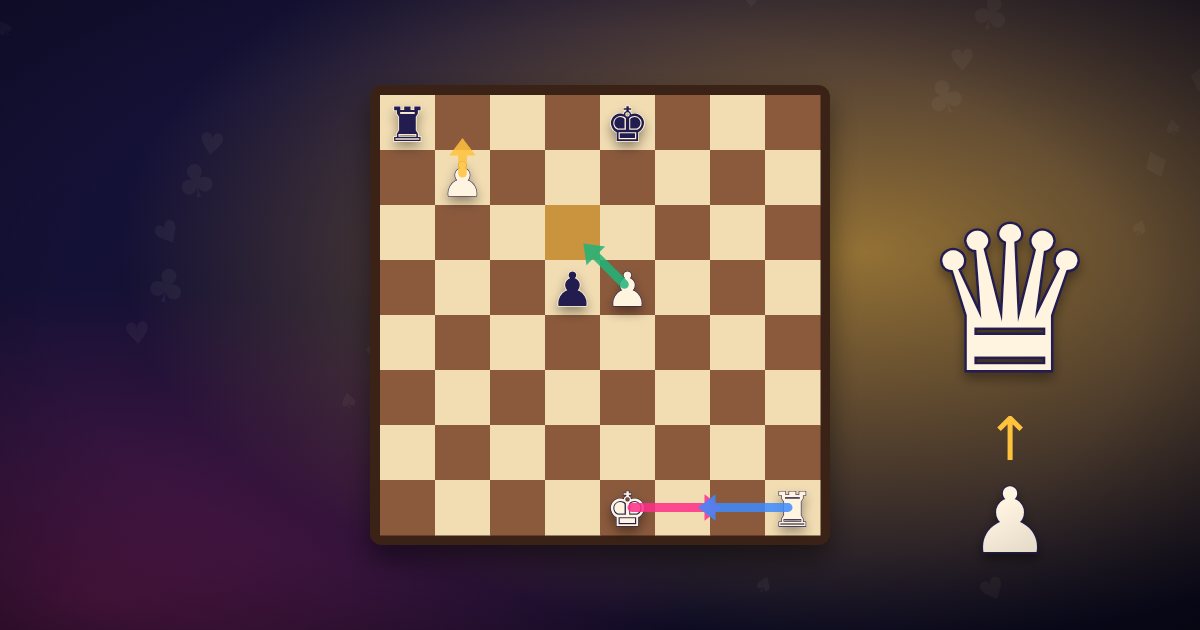
- Kingside (short) castling, written O-O: the king moves two squares towards the h-rook, and the rook jumps to the square on the king's other side. White ends with the king on g1 and rook on f1.
- Queenside (long) castling, written O-O-O: the king moves two squares towards the a-rook, and the rook jumps over. White ends with the king on c1 and rook on d1.
Move the king first, then the rook.
You can't castle if…
- Your king has already moved (even if it moved back).
- That rook has already moved.
- There are pieces between the king and the rook.
- Your king is in check right now; you can't castle out of check.
- The king would pass through a square attacked by the opponent.
- The king would land on an attacked square.
Note that the rook may pass through an attacked square (this matters in queenside castling), and a rook under attack can still castle.
2. En passant
"En passant" is French for "in passing". It's a special pawn capture.
How it works
- Your pawn is on its fifth rank (for White, the 5th row; for Black, the 4th).
- An enemy pawn on a neighbouring file moves two squares forward from its starting square, landing right beside your pawn.
- On your very next move only, you may capture it as if it had moved one square: your pawn moves diagonally forward into the square it skipped, and the enemy pawn is removed.
If you don't capture immediately, the chance is gone.
Why it exists
When pawns gained the two-square first move, en passant was added so that a pawn couldn't simply sneak past an enemy pawn without risk.
3. Pawn promotion
When a pawn reaches the last row (the 8th for White, the 1st for Black), it must be promoted on the same move to a:
- Queen (almost always the best choice),
- Rook,
- Bishop, or
- Knight.
You can promote to a queen even if you still have your original queen, so it's possible to have two or more. Promoting to something other than a queen is called underpromotion. It's usually done with a knight (to give an immediate check or fork) or a rook or bishop to avoid stalemate. More on that in checkmate vs stalemate.
Quick reference
| Move | Pieces | Key condition |
|---|---|---|
| Castling | King + rook | Neither has moved; no check; path not attacked |
| En passant | Pawn | Immediately after an enemy pawn's two-square move |
| Promotion | Pawn | Reaches the last rank; must become Q, R, B or N |
For the official wording, see Castling on Wikipedia and En passant on Wikipedia.
Practise the special moves
Apps enforce the rules automatically, which makes them a great way to learn. Board Adda: Ludo Carrom Chess only lets you castle or capture en passant when it's legal, so you learn the conditions by playing. It's free and offline.
FAQ
Can you castle out of check?
No. You can't castle while your king is in check, or through or into an attacked square.
Can you castle if the rook is under attack?
Yes. Only the king's current square, the square it passes through and the square it lands on must be safe.
Is en passant compulsory?
No. It's optional, but it must be done immediately after the enemy pawn's two-square move or not at all.
Can you have two queens in chess?
Yes. Promoting a pawn to a queen gives you an extra queen even if your original is still on the board.
Board Adda: Ludo Carrom Chess
Ludo, carrom, chess and 10 more board games. Free, offline, on Android.