Chess Piece Values: Points for Every Piece and When to Trade
Chess piece values explained: pawn 1, knight 3, bishop 3, rook 5, queen 9, plus the bishop pair, the king in the endgame and how to judge good trades.
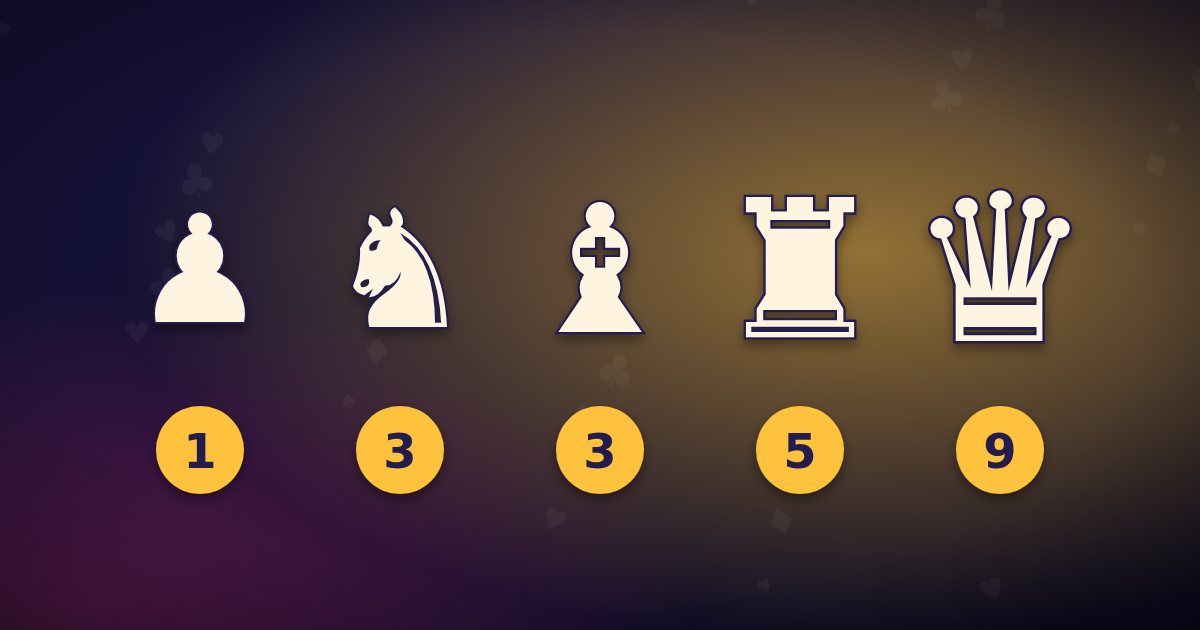
The standard chess piece values are simple: pawn 1, knight 3, bishop 3, rook 5, queen 9. The king has no points value because it can never be captured or traded. Add up the points on each side and you have a quick way to tell who's ahead in material and whether a trade is worth making.
These numbers are guidelines, not laws. A well-placed knight can be worth more than a buried rook, and a pawn about to promote can be worth more than a bishop. But every strong player knows the scale by heart, and learning it is the fastest way to stop giving pieces away.
Objective: why piece values matter
Chess is won by checkmate, not by points. So why count? Because material is the most reliable long-term advantage. If you're a rook up, you'll usually be able to force mate eventually. Piece values help you:
- Decide whether a capture or a sacrifice is good for you.
- Spot when your opponent is offering a bad trade.
- Know when to simplify and when to keep pieces on.
If you still need a refresher on how each piece moves, see our chess rules for beginners.
The chess point system at a glance
| Piece | Symbol | Value (points) | Number per side | Total |
|---|---|---|---|---|
| Pawn | (none) | 1 | 8 | 8 |
| Knight | N | 3 | 2 | 6 |
| Bishop | B | 3 | 2 | 6 |
| Rook | R | 5 | 2 | 10 |
| Queen | Q | 9 | 1 | 9 |
| King | K | No value (can't be traded) | 1 | n/a |
Each side starts with 39 points of material.
How each value is earned
Pawn: 1 point
The pawn is the unit of measurement. It's the weakest piece, but it can promote to a queen on reaching the last rank, which makes passed pawns far more valuable in an endgame. Our guide to castling, en passant and promotion covers how promotion works.
Knight: 3 points
Knights jump, so they're at their best in closed positions with locked pawns. They're slow to cross the board and weak on the edge ("a knight on the rim is dim").
Bishop: 3 points (often a little more)
Bishops sweep long diagonals and shine in open positions. Many players and engines rate a bishop slightly above a knight, around 3¼, but for everyday counting 3 is fine. A single bishop only ever covers squares of one colour, which is its main weakness.
Rook: 5 points
Rooks need open files and become powerful in the endgame, especially on the seventh rank where they attack pawns from behind.
Queen: 9 points
The queen combines rook and bishop movement, which makes her the most powerful piece. Two rooks (10) are usually a little better than a queen (9), but it depends on how coordinated the rooks are.
Common trades, scored
| Trade | Points | Usually… |
|---|---|---|
| Knight for bishop | 3 for 3 | Even; depends on the position |
| Rook for knight or bishop ("losing the exchange") | 5 for 3 | Bad by about 2 points |
| Rook for minor piece + pawn | 5 for 4 | Slightly bad, often playable |
| Two minor pieces for rook + pawn | 6 for 6 | Even on paper; the minors are often stronger in the middle game |
| Queen for rook + minor piece | 9 for 8 | Roughly even |
| Queen for two rooks | 9 for 10 | Roughly even, slight edge to the rooks |
| Three minor pieces for queen | 9 for 9 | Even on paper; the pieces often coordinate better |
Winning a rook for a minor piece is called winning the exchange; it's a common tactical goal worth around 2 points.
The bishop pair
Two bishops working together cover both colours and dominate open boards. This bishop pair is usually rated as worth about half a pawn extra. So if you trade a bishop for a knight and your opponent keeps both bishops, you may have given them a small, lasting edge, even though the points look equal.
The king's value in the endgame
The king can't be traded, so it gets no points value in counting. But in the endgame, once the queens are off and mating attacks are unlikely, the king becomes a strong fighting piece. Its attacking and defending power is often compared to roughly that of a minor piece. Rule of thumb: in the endgame, bring your king to the centre. A king that stays tucked in the corner while the opponent's king marches in is a common way to lose a level ending. For the difference between winning and drawing there, see our guide to checkmate vs stalemate.
When are trades good?
Points tell you what a trade costs. These principles tell you whether you want it.
- Trade when you're ahead. Swapping pieces (not pawns) makes an extra pawn or piece count for more. A rook against nothing is decisive; a rook up with everything else still on the board is harder to convert.
- Avoid trades when you're behind. Keep pieces on and look for counterplay or tactics.
- Trade your bad pieces for their good ones. A bishop blocked by its own pawns is worth less than 3; swapping it for an active enemy knight is a win in practice.
- Trade attackers when you're defending. If your king is under fire, exchanging your opponent's attacking pieces eases the pressure.
- Keep pieces on when you're attacking. Every trade removes a potential attacker.
- Think about the endgame you're heading into. Rooks and bishops tend to get stronger as the board empties; knights are often best with pawns on one side.
Variations: other value scales
The 1/3/3/5/9 scale is the classic one, but it isn't the only system. Some coaches and authors use 3.25 for bishops and knights a shade lower, or rate rooks closer to 5.25 and queens to 9.5 or 10. Chess engines don't use fixed numbers at all; they adjust values for the position. For learning, the simple scale works perfectly. For more on the history and alternative scales, see the Wikipedia article on chess piece relative value.
Common mistakes
- Counting points but ignoring threats. Winning a knight is useless if you get mated next move.
- Trading a bishop for a knight without thinking. The bishop pair matters on open boards.
- Undervaluing passed pawns. An advanced passed pawn in an endgame can be worth a piece.
- Hiding the king in the endgame. Once the queens are off, activate it.
- Treating values as fixed. A trapped piece is worth far less than its number; a dominant one is worth more.
Play chess offline
Board Adda: Ludo Carrom Chess includes chess among its 13 classic board games, all playable offline. Try keeping a running material count in your next game against the computer: you'll quickly notice when a trade goes against you. If you're ready to improve your first moves too, read our chess openings for beginners.
FAQ
What is the point value of each chess piece?
Pawn 1, knight 3, bishop 3, rook 5 and queen 9. The king has no points value because it can't be captured.
Is a bishop worth more than a knight?
They're both usually counted as 3, but many players rate the bishop slightly higher, especially in open positions. Two bishops together (the bishop pair) are generally worth about half a pawn extra.
How much is a queen worth in chess?
A queen is worth 9 points, roughly equal to a rook plus a minor piece, or slightly less than two rooks.
Why does the king have no value in chess?
The king can never be captured or traded, so the game is lost if it's checkmated. That makes it beyond any points value, although it becomes an active fighting piece in the endgame.
Is it good to trade pieces in chess?
It depends. Trading is usually good when you're ahead in material or swapping off your opponent's best attacker, and usually bad when you're behind or leading an attack.
Board Adda: Ludo Carrom Chess
Ludo, carrom, chess and 10 more board games. Free, offline, on Android.